

CHAPTER ONE
Nicolas Perrin is seven years old, and he is certain that the snow is magic.
He stands at the edge of the walkway in front of his house, boots half-laced and pajama cuffs tucked into them like he dressed in a hurry. His red coat is a size too big, the sleeves swallowing his hands unless he pulls them tight. A fuzzy green hat leans to one side on his head. His breath curls in the cold like tiny dragons.
The snow drifts down under the streetlamp across the yard, not falling fast but floating, like it’s trying to decide where to land. Each flake glows gold in the light, spinning slowly, like it knows it’s being watched.
Nicolas watches.
He doesn’t say anything at first. Just stares up at the sky, lips parted slightly, blinking flakes from his lashes. His cheeks are pink. His nose is red. But he doesn’t notice. Or mind.
It’s Christmas Eve, and it feels like it.
Not just because of the lights wrapped around the porch railing, or the smell of cinnamon coming from the house, or the carols playing softly inside. No, this feeling is different. Deeper. Quieter. Like the whole world is holding its breath, just waiting for something wonderful.
He takes one small step forward, closer to the light, and tilts his head all the way back. The snowflakes tickle his face, landing on his cheeks and the tip of his nose.
He giggles.
Then he sticks out his tongue and catches one.
“Mmm,” he says, smacking his lips like a food critic. “Tastes like… cold marshmallows. Or maybe cloud sprinkles.”
He laughs again, soft and breathy, and spins once in place, arms out wide, like he’s trying to hug the air.
“Hi, snow,” he whispers, looking up. “I like you. Don’t stop yet.”
Across the street, someone’s window glows with blinking red and green lights. Somewhere far away, a dog barks. Closer, wind chimes ring gently on a porch.
But mostly, it’s quiet.
Magic quiet.
Nicolas closes his eyes and just listens.
Then he opens them and whispers something to the sky, not loud, not even fully formed. Just a small string of sounds, like a wish only the stars are meant to hear.
Behind him, the house glows warm through the curtains. He can hear a door open, just barely, and the soft clink of mugs being set down on a table.
He turns his head but doesn’t go in.
Not yet.
Right now, the world feels just right. Like a secret. Like a story that hasn’t been told yet.
And Nicolas Perrin doesn’t want to miss a single word of it.
The living room feels like a snow globe that’s just been shaken.
Everything is soft and still and glowing. The tree reaches all the way to the ceiling, its branches full and brave, wrapped in blinking lights and glittering ribbons. The fireplace hums, popping and crackling like it’s telling stories only the flames can understand. Outside the window, the snow is still falling, each flake catching the light as if the magic followed him inside.
Nicolas steps inside and closes the door behind him. The warmth rushes to meet him, fogging his glasses for a second. He peels off his coat and hat and tosses them on the chair by the fireplace without looking. He doesn’t need cocoa. Not yet. Not even slippers. He’s not ready to be done with the magic.
The house smells exactly how magic should smell, like cinnamon and pine needles and warm sugar. The kind of smell that makes you feel safe. Like something good is just around the corner.
Just as he started toward the tree, he heard his mother’s voice float in from the kitchen.
“Nic, want to help with Santa’s plate?”
He spun around without hesitation.
The kitchen was bright and warm, all golden light and soft shadows. His dad was already there, tying a ribbon around a small bell to place next to the cup. His mom handed Nicolas the holiday plate, the one with the dancing reindeer and the little chip on the edge.
Three cookies. One chocolate chip, one gingerbread, one with red and green sprinkles that looked like it had been decorated in a snowstorm. Nicolas had made that one himself. It wasn’t pretty, but it was big. He made sure it went right in the center.
His dad handed him the glass of milk.
“Steady now,” he said, and Nicolas grinned like he was carrying a sacred artifact.
They walked together to the small table by the fireplace.
The plate went down with care. Then the glass. Then, finally, the bell — positioned just right.
“Perfect,” his mom whispered.
“Too perfect,” Nicolas added, eyebrows raised. “He’ll think it’s a trap.”
His dad chuckled.
They stood there for a beat, just the three of them, admiring their work. The fire popped softly beside them.
Then Nicolas whispered, almost to himself, “He’s gonna love it.”
His mom kissed the top of his head. “Of course he will.”
She paused. “Oh! Before I forget, look who came down from the attic today.”
She walked over to the far side of the living room and pulled a large plastic tub out from behind the couch. Its lid was taped at the corners, just like always. On top, in faded marker and childlike lettering, was the name that had stuck since Nicolas was four:
Merryweather
(“Keeper of Christmas. Beware of tangled lights.”)
Nicolas gasped.
“Merryweather! He made it!”
“Barely,” his mom said. “He put up a fight. Nearly took me and your dad both to get him down the stairs.”
Nicolas knelt beside the old storage bin, as if greeting an old friend.
He placed a hand gently on the lid, which always stuck a little. You had to twist it just right to get the latches to pop.
Inside: magic.
Wrapped in tissue paper, tangled in tinsel, the ornaments were like old friends returning from a long nap. Nicolas pulled each one out carefully, whispering hello like they were people. Which, to him, they kind of were.
The sparkly bell? That was Gregory. He used to be a knight. Now he ran a bookstore in the clouds.
The little cloth mouse with the red scarf? Matilda. She could speak every language but only when no one was listening.
And then he found them.
The beads.
The long string of plastic decorating beads, all red and gold and green, coiled at the bottom of the bin like a sleeping dragon.
Nicolas pulled the strand out slowly, letting it drape across his arms like treasure. Then he looped it into a big circle on the carpet, crouched down, and slowly, carefully, pulled the center up with both hands.
The beads followed.
They rose from the floor like magic, like a golden snake charmed by invisible music, clinking softly as the light caught every angle. For a moment, it shimmered and danced in the air, rising into a perfect dome of color and light.
Nicolas’s eyes widened.
“Whoa…” he breathed. “It’s a bubble of Christmas.”
He let it fall, and the beads scattered across the carpet with a satisfying hiss.
He places the beads aside and drops to his knees.
He crawls underneath the Christmas tree and it’s like he’s entering another world. The branches hang low and heavy, brushing his hair as he slides in. It’s darker under here, but the lights are brighter somehow, like stars behind a curtain of green.
He pulls the blanket from the couch over his legs and folds his arms behind his head. From this angle, the tree looks endless, like a world turned upside down. The ornaments dangle like treasure maps and spells. The gold star at the top peeks through the branches, like it’s watching him.
“Hey,” Nicolas whispers, “I’m back.”
He picked up right where he left off with his old friends from last year.
The reindeer with one missing eye? That’s Captain Dasher. He’s a sky pirate now.
The wooden toy soldier? Retired. Runs a bakery in the clouds.
He waves a hand toward the glittery sleigh tucked into the middle branches.
“You’re gonna fly tonight,” he says, eyes wide. “I know it.”
The sleigh doesn’t move, but he doesn’t expect it to. Not yet. Magic always waits until you’re asleep.
The fireplace crackles louder behind him. The lights on the tree blink slow and steady.
Red. Green. Gold. Blue.
He watches them without blinking, like they’re trying to send him a message in a secret code. Maybe they are. Maybe only kids can read it.
The tree smells like winter and hope. The branches above sway just a little from the heat of the fire. The angel near the top wobbles in her place, and Nicolas grins.
“Hold on,” he tells her. “Almost there.”
He presses a hand against the carpet, feeling how scratchy it is through the blanket. A pine needle sticks to his sleeve. He doesn’t brush it off. It feels like a badge. Like proof he was here.
The lights blink again.
He closes his eyes, just for a second, and whispers to no one:
“Please let me hear the sleigh bells.”
When he opens them, everything is the same.
And somehow, that makes it even more perfect.
Then something shifts in his memory.
His eyes snap open.
“The snow!”
He scrambles out from beneath the tree, blanket trailing behind him, and pads quietly up the stairs. He stops in front of his sister’s room and taps gently on the door.
“Lucy?” he whispers. “Luce?”
A sleepy groan followed by, “Yes, Nick. I know it’s snowing.”
“Yeah!” he replies, with a giant smile growing on his face.
“Could you do me a favor though? Could you not walk in the side yard tomorrow morning?”
“What?”
“The side yard,” he repeats. “That stretch of snow between the driveway and the fence. It’s always the most perfect-looking part.”
She doesn’t answer.
“It looks like magic when nobody walks through it,” he continues. “Like the world is new. You always cut through it to get to the sleds and you ruin the whole thing.”
A long pause. Then: “Fine,” she mumbles, and turns over.
Nicolas smiles.
He turns and walks softly back downstairs.
Some people just need reminding.
Back under the tree, Nicolas lifts one finger and points to a snowman ornament made of felt and buttons.
“You’re on bell patrol,” he says. “You have to ring exactly once if Santa’s early. Twice if he forgets his hat again.”
He turns to a wooden reindeer, antlers chipped at the top.
“Captain,” he says, voice low and serious. “The skies are clear. Launch sequence begins when the cookies are warm.”
The tree lights blink slowly. Red. Blue. Gold. Green.
He grins. His voice drops into a whisper as he leans close to a dangling candy cane made of beads.
“You’re the decoy,” he says. “Hide by the chimney. If the cat shows up, distract him with jazz hands.”
Behind him, the floor creaks.
Nicolas hears it but doesn’t look up. He’s too deep in it. Too close to liftoff.
Then he hears the slow sound of knees meeting carpet. A pause. A breath.
And then a rustle beside him.
He turns his head.
His Grandpa is lying on his back. Right beneath the tree.
His sweater bunches around his stomach. One arm rests behind his head. The other rests on his chest. He stares up through the branches, eyes soft, blinking against the shifting lights.
“Grandpa.” Nicolas whispers.
Just the word. But it carries something full and warm.
Grandpa turns his head slightly. Their eyes meet.
Nicolas smiles. A simple, quiet smile, like he’s glad his grandpa found the way in.
Then he turns back to the ornaments.
“The elf squad’s almost ready,” he says. “They’re waiting for the launch bell. They’ve got marshmallows, glitter rope, and one banana. I don’t know why. They just do.”
Grandpa doesn’t laugh. Not loudly.
He just watches.
Listens.
Feels.
Nicolas continues his mission, pointing to each ornament like it’s part of a constellation only he can see. His words come softly, but they’re rich with certainty. The candy cane has a jetpack. The mouse with a scarf is the North Pole’s head librarian. The angel near the top can speak twelve languages, thirteen if you count reindeer.
Grandpa’s smile is the kind that starts small and stays. His eyes move from ornament to ornament, following Nicolas’s finger. He doesn’t say a word, but something inside him shifts.
The kind of shift you feel in your chest when an old song plays and you suddenly remember every word.
He watches his grandson with a quiet admiration.
There’s a softness in his face now. A smile that doesn’t quite reach his lips but lives in the lines beside them. In his stillness, something flickers. Something old. Not faded, just tucked away.
Wonder.
The kind he thought had been folded up and left behind somewhere long ago.
But here it is—alive again, glowing in the voice of the boy beside him.
Then, gently, he reaches into the pocket of his cardigan.
A small cloth bundle.
He lays it beside Nicolas.
The boy pauses. Looks at it. Then up.
Grandpa’s voice is quiet, just above the sound of the fire.
“These aren’t just mittens, Nic,” he says. “They’re a little bit of Christmas you can take with you.”
Then he reaches out, smooths Nicolas’s hair with the side of his hand, and slowly stands up.
Nicolas doesn’t speak.
He unwraps the bundle slowly. The wool is soft. Red. A little fuzzy, but warm. Worn in the way that means they’ve been loved.
He slips them on, one hand at a time. Then wiggles his fingers.
They fit.
Not perfectly.
But perfectly enough.
He glances toward the window, snowflakes still spinning down under the golden street lamp.
He smiles at the sight, the same way he had smiled as his Grandpa.
“Hi, snow,” he whispers again. “Don’t stop yet.”
And Nicolas Perrin, age seven, lying under a tree on Christmas Eve with a blanket on his legs and mittens on his hands, closes his eyes with childlike content, like the world just gave him a secret, as the snow continues to fall.
In the next town over, the Bolzani house was already bursting with holiday joy.
The front door never rested. It swung wide, gulping a gust of night air along with the latest arrivals, then slammed shut only to fling itself open again moments later. Each entry carried a little storm: boots stamping snow onto the mat, scarves unwinding, trays of food balanced like trophies, folding chairs banging doorframes. The reading chair in the front parlor disappeared beneath a rising tide of coats and hats until it looked like a mountain had grown inside the house.
“Careful! Don’t drop the cookies!” Aunt Rosa scolded as she shuffled in with a pan covered in foil. Behind her, Uncle Sal followed with two bottles of wine tucked under one arm and a chair dragging at his heels. From upstairs, a cousin’s laugh rolled down the staircase and somehow merged perfectly with the chatter in the kitchen. The house took every new sound and wove it into the fabric of the night.
The kitchen was the center of gravity. Pots crowded the stovetop, lids clicking as steam tried to escape. Garlic browned in olive oil, sweetened by the tang of tomatoes; lemon sliced sharp through the air where fish sizzled and popped in shallow pans of oil. Desserts lined the counter like an army waiting for orders: cannoli in neat rows, cheesecakes, a homemade icebox cake, and the family favorite, Cousin Tracy’s Death by Chocolate.
From the living room, Bing Crosby’s voice drifted out of the record player, the notes softened by age. The carol threaded the air, quickly swallowed by the chorus of the house, conversations spilling over one another, laughter bouncing between rooms. A question from the kitchen might be answered from the hallway; a joke begun on the stairs finished in the dining room.
In the middle of it all stood Eve, seven years old, her braid loosening from the speed of her movements. She slipped between legs and arms, stealing kisses from relatives and cookies from trays. She hugged Aunt Teresa tight, then wriggled free and sped into the kitchen, bumping against Nonna’s leg as she passed. Without thinking, Eve reached toward the simmering pan on the stove, her fingers stretching for the spoon.
Nonna snapped the wooden spoon down with a sharp tap. “No, no! You’ll burn yourself,” she scolded, her voice firm.
Eve’s hand fell back, her eyes wide. For a moment Nonna’s stern gaze held, and then it softened into a smile. She reached for the loaf of bread on the counter, tore off a crusty end, and split it cleanly in two and placed one piece into Eve’s small hand, then leaned close, her voice dropping to a whisper.
“This is just for us. Our secret.”
Nonna popped her own piece into her mouth with a wink.
Eve lit up, certain she and Nonna now shared a secret magic all their own.
The tree stood glowing in the corner of the living room, its lights blinking in steady rhythm, ornaments shimmering when cousins brushed past. Beautiful as it was, it seemed content to step back from the spotlight. Tonight, the real centerpiece was the living, moving storm of people: the shuffle of trays from oven to table, the laughter that clung to the walls, the children racing down the hallway in socks, the grown-ups raising voices just enough to be heard over it all.
Eve inhaled every bit of it, the warmth, the smells, the overlapping sounds. This was Christmas for her: a house too small for the amount of love it held, spilling over at the seams.
When dinner ended, the house still hummed with its echoes. Plates sat stacked at the ends of the table, crumbs scattered across the tablecloth like confetti. The adults lingered in their chairs, talking in overlapping circles, voices lowered but still bright, laughter breaking out in bursts that seemed to shake the chandelier.
And then Anna, one of the older cousins, spoke up. She was seventeen, tall, and carried herself with the kind of authority the younger kids automatically trusted.
“You know,” she began casually, just loud enough for the cluster of younger cousins to hear, “I heard Santa’s heading our way.”
The children froze mid-whisper, eyes widening.
“Really?” one of them asked, clutching at Eve’s sleeve.
Anna nodded, her gaze flicking toward the little ones with just enough gravity to convince them. “We’d better get downstairs before he gets too close. If we’re lucky, we might even see his sleigh through the window.”
That was all it took. Excitement erupted like a spark on dry tinder. Daniel, a college-aged cousin home for break, appeared in the hallway with a worn red book in hand. He grinned as he waved it. “C’mon, we’ll read this while we wait. That way, if he shows up, we’re ready.”
They bustled toward the basement, feet thudding on the steps, socks slipping across the carpet at the bottom, voices echoing in the stairwell, the herd settled into the finished room.
The cousins sprawled across the carpet, forming a messy circle. Some leaned against the couch; others stretched out on their bellies. Eve nestled between two younger cousins, hugging her knees, her braid brushing her shoulder as she leaned forward, eyes wide.
Daniel cleared his throat and opened the book. “‘Twas the night before Christmas, when all through the house…”
The words tumbled out warm and steady, wrapping around the children like a blanket. Eve mouthed some of the lines silently, already knowing them by heart, though Daniel’s voice gave them new life. The littlest cousins gasped at the stockings and giggled when the reindeer were named.
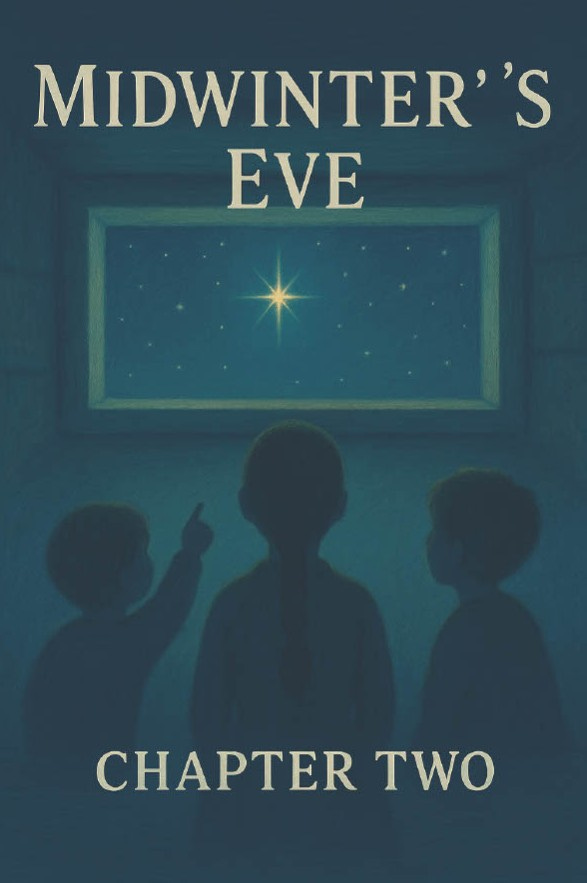
Halfway through, Anna’s hand shot up toward the half-frosted basement window, her eyes wide. “Look!” she whispered urgently.
The room exploded into motion. The children scrambled to the window in a flurry of elbows and socks, tripping over one another in their rush. Eve pressed against the cold glass, her breath fogging it instantly, her small hands cupped on either side of her face.
There it was, a single bright light in the night sky, sharper and stronger than all the rest.
Eve’s heart leapt. She didn’t know what it was, and she didn’t think to question it. To her, it could only be one thing. It had to be Santa.
“See? He’s getting closer,” Anna breathed, hushed but steady.
The younger cousins squealed, bouncing on their toes. Eve’s chest fluttered with a joy so strong it almost hurt.
Daniel’s voice brought them back. He had resumed the reading, his tone deeper now, more theatrical, carrying the magic forward: “‘More rapid than eagles his coursers they came, and he whistled, and shouted, and called them by name…’”
The children sank back down, still buzzing from the glimpse of the sky, their imaginations glowing as bright as the star.
For Eve there was no question, no doubt. Santa was close, she could feel it.
While the cousins pressed close to the window and Daniel’s voice carried the poem through the basement, the adults upstairs slipped into motion.
The front door opened in a rhythm now, quick gusts of cold, boots crunching the porch, arms full of wrapped boxes and bags.
“Careful, careful,” Eve’s father murmured as he shifted a stack of gifts higher in his arms. His sister trailed behind, dragging two more bags, ribbon handles cutting into her fingers.
“Where are we putting them?” asked Uncle Ralph, his breath puffing as he stamped snow from his shoes.
“In the living room, like always,” came the reply. “Pile them right in the middle.”
One by one, the presents formed a mountain. Bright paper shimmered under the glow of the tree, ribbons curled in cascades, tags fluttered as they were set down. The tree itself stood tall, its lights twinkling steadily, as if it knew it was in on the secret.
At the edge of the pile, Eve’s mother set down a red box, straightening the bow before stepping back to survey the scene. “It never looks like enough until you see it all together,” she whispered, half to herself.
“Which kids still believe?” Aunt Maria asked as she slid another package onto the stack.
“Austin, for sure.”
“Rosie, depending on the day.”
“And Eve?”
A pause. A shrug. “She’s seven. She’s still all in.”
They didn’t linger. More trips to make, more bags to bring in from trunks waiting in the driveway. The door swung open again, another gust of cold, another armful of packages shuffled into the growing mountain.
And beneath their feet, in the basement, the children huddled close, their voices rising and falling with Daniel’s reading. One world was waiting, wide-eyed and certain; the other was working, careful and unseen, two halves of the same tradition unfolding at once.
It began faintly, almost hidden beneath Daniel’s steady reading: a jingle, light and far away, like bells caught in the wind.
The cousins froze. Daniel’s voice faltered, and then it came again, louder this time, unmistakable. Bells.
And then, the voice. Deep, booming, rolling through the house as if the walls themselves carried it:
“HO! HO! HO!”
The basement erupted. Blankets flew, elbows jabbed, the youngest squealed so loudly the sound bounced off the low ceiling. Anna snapped the book shut, grinning ear to ear. “He’s here! Santa’s here!”
The children stampeded toward the stairs, socks sliding on the steps, palms smacking the railing for balance. Eve’s heart thudded; her breath came in bursts of laughter and gasps as she raced with the others. The door at the top burst open, and they spilled into the light.
The living room had transformed.
Where moments ago the carpet had been bare, a mountain of presents now glittered beneath the tree. Boxes in red and green, bags with curled ribbons, it all shimmered together like something that had grown out of the floor itself. And next to the tree, in Nonna’s armchair, which tonight looked more like a throne, sat Santa Claus.
“Merry Christmas!” Santa boomed, his voice vibrating through the air.
Cheers broke out. Some clapped without meaning to. Others bounced on their toes, faces flushed and glowing. Eve felt her chest swell until she thought she might float away.
Names were called one by one, and each child stepped forward in awe. The littlest were lifted onto his knee, eyes wide as he handed them a wrapped gift. The oldest cousins tried to play it cool but failed, grinning anyway when their names were spoken.
And then, “Eve!”
Hearing her name in Santa’s voice sent a shiver down her legs. She stepped forward, hardly breathing, the room narrowing into a tunnel of light and ribbon. Santa leaned down, eyes twinkling, and placed a red-and-green box into her hands.
“Thank you,” she whispered.
Santa smiled and gave her a nod. Before he could linger, Eve’s father stepped forward, clapping his hands. “All right,” he said gently, glancing at the children. “Santa is very busy tonight. So he has to get going.”
The words worked like a cue. Santa gave a weary chuckle and a wink. “Very busy indeed.”
Then came the part that belonged as much to the adults as to the kids. Aunt Rosa went first, flopping onto Santa’s lap with a dramatic sigh, laughing like a teenager as the cousins squealed. Aunt Teresa followed, striking a pose just as the camera flashed. Then Uncle Tony, broad-shouldered and booming, dropped into the chair with such force it let out a sharp crack. Both he and Santa jumped up at once, their faces flashing between alarm and laughter.
The room roared. Children and grown-ups alike doubled over, the whole family caught in the same web of joy.
With a final jingle of the bells and one last booming “HO HO HO,” the door opened, a gust of cold swept through the hallway, and Santa was gone.
For a single beat, silence held the room, as if no one dared breathe, afraid the magic might slip away.
And then, all at once… chaos.
Wrapping paper tore in violent, joyous strips. Bows popped and vanished under furniture; ribbons curled into nests across the rug. Cousins shouted thanks across the room as gifts were revealed.
“THANK YOU, AUNT LINDA!” came from one corner, a sweater dangling down to a cousin’s knees.
“THANK YOU, TONY!” another cried, holding a shiny fire truck overhead.
The answers were shouted back through laughter: “You’re welcome!” “Glad you like it!”
Eve was in the middle of it, her braid half undone, cheeks pink from the heat of the room and her own excitement. She ripped into her boxes with both hands, squealing when a doll tumbled into her lap, then tearing into another to find a book wrapped in shiny green foil. She pressed her face to its new-paper scent, then tossed it aside to attack the next box like the others, shrieking and laughing as the living room filled with treasures.
Parents hovered at the edges with scissors and screwdrivers, freeing toys from impossible packaging. Batteries snapped into place, wheels spun, buttons beeped.
“Don’t lose the pieces!” someone shouted.
The frenzy lasted until the smell of chocolate and coffee drifted in from the dining room, tugging everyone back.
Dessert transformed the table into another feast. Cannoli lay in neat rows, their ends dusted with powdered sugar. Cousin Tracy’s famous Death by Chocolate towered like a monument, rich enough to silence the room for a moment with each first bite.
Children darted between the dessert table and their new toys, sticky fingers leaving smudges on boxes. Adults sipped coffee and leaned into their chairs, the volume of laughter dipping slightly, softer but no less warm.
Eventually, the night began to unspool.
Plates stacked in the sink, crumbs brushed away. Coats were dug out of the heap on the armchair in the front room, the same yearly scavenger hunt. “Is this mine?” someone called, holding up a sleeve. “What does yours look like again?” Another cousin insisted, “Mine’s the pea coat with red buttons!” It never failed; the pile caused confusion before anyone could get out the door.
In the driveway, cars were opened and re-opened, parents shuffling the packages they’d brought in earlier back out to the cars, arranging them like puzzle pieces. One family with a new baby drew the most laughter, struggling to wedge the overabundance of toys and clothes around a car seat and folded stroller.
“Try the back seat!” someone called.
“There’s no room in the back seat!” came the muffled reply.
At the doorway, relatives laughed and shouted advice no one followed. “Take it out of the box!” “Turn it sideways!” Laughter and exasperation filled the air. Eventually, as always, doors slammed, the last bag was forced into place, and parents climbed in, weary but smiling.
Engines rumbled; headlights swept across the snow; tires crunched down the icy driveway. One by one, the cars slipped away until the house, stretched full all night, finally exhaled back into stillness.
Upstairs, Eve brushed her teeth with clumsy strokes, too tired to care about the minty foam dripping down her chin. She tugged on her flannel pajamas and padded into her bedroom, arms heavy with the weight of the night.
Her mother followed, smoothing the blanket up to Eve’s shoulders and tucking it close. She paused, her hand resting gently on her daughter’s hair.
“Goodnight, Eve,” she whispered. “I hope you had a great Christmas.”
Eve’s smile stretched wide, her eyes heavy but still shining. “The best!”
Her mother bent lower, her voice softer. “I love you… to the moon and back.”
“I love you too, Mom,” Eve murmured, her voice drifting as sleep began to pull her under.
Her mother clicked off the light, leaving only the soft glow from the hallway.
Eve curled toward the doll on her nightstand. She carried the night inside her, Santa’s booming laugh, cousins squealing, the star in the frosted window, desserts and laughter still sweet on her tongue. She felt full in a way words couldn’t reach.
And in the next town over, Nicolas Perrin lay in his own bed, wide awake, heart racing with hope and anticipation for what the morning might bring. Eve, by contrast, let sleep take her easily. For her, the magic had already happened, wrapped in the noise and love of her family.
The classroom is too warm, even for December.
The radiator hisses against the wall; the air smells faintly of chalk and old metal. The teacher moves carefully through fractions, stacking numbers on the board in tidy rows. The other students bend over their notebooks, pencils scratching in steady rhythm.
Nicolas, now nine, tries. He really does. He sits at his desk, pencil gripped tight, copying the numbers line by line, until the shapes begin to shift in front of him. The one stretches tall, sprouting antlers, a reindeer charging across his notebook. The zero beside it swells into a snowball, round and perfect. The fraction bar grows longer, wider, until it becomes a horizon with a sleigh streaking across the sky. Without meaning to, he sketches a reindeer with rocket boosters.
He grins to himself, then forces his pencil back to the task. The work isn’t hard. It just… isn’t alive. Not like the things that take shape when he lets his mind wander.
He blinks, and the room returns. He looks toward the windows at the far end of the room, where the sky is pale gray. At first it seems empty, and then tiny snowflakes begin to fall. Not many, just a few, tilting and spinning in slow motion, enough to catch in the bare branches of the oak tree by the fence.
The numbers on the board blur. He watches each flake float down and stick, slow and stubborn, like the world is decorating itself just for him.
Warmth blooms in his chest that has nothing to do with the radiator. He wonders if the snow remembers him.
He whispers, “Hi, snow.”
The chalk squeaks. The teacher keeps talking. Nicolas doesn’t hear a word. His whole body hums with that fizzy anticipation, as if the snow has been waiting for him to notice.
And then the bell rings. Books slam shut. Chairs scrape. The room erupts in motion before the teacher can remind anyone to stay focused. Nicolas blinks once more at the window, tucks his pencil away, and slips into the stream of students rushing for the door.
“Homework first!” his mom calls from the kitchen when he barrels through the back door after school.
“Already did it!” Nicolas answers, which is not true.
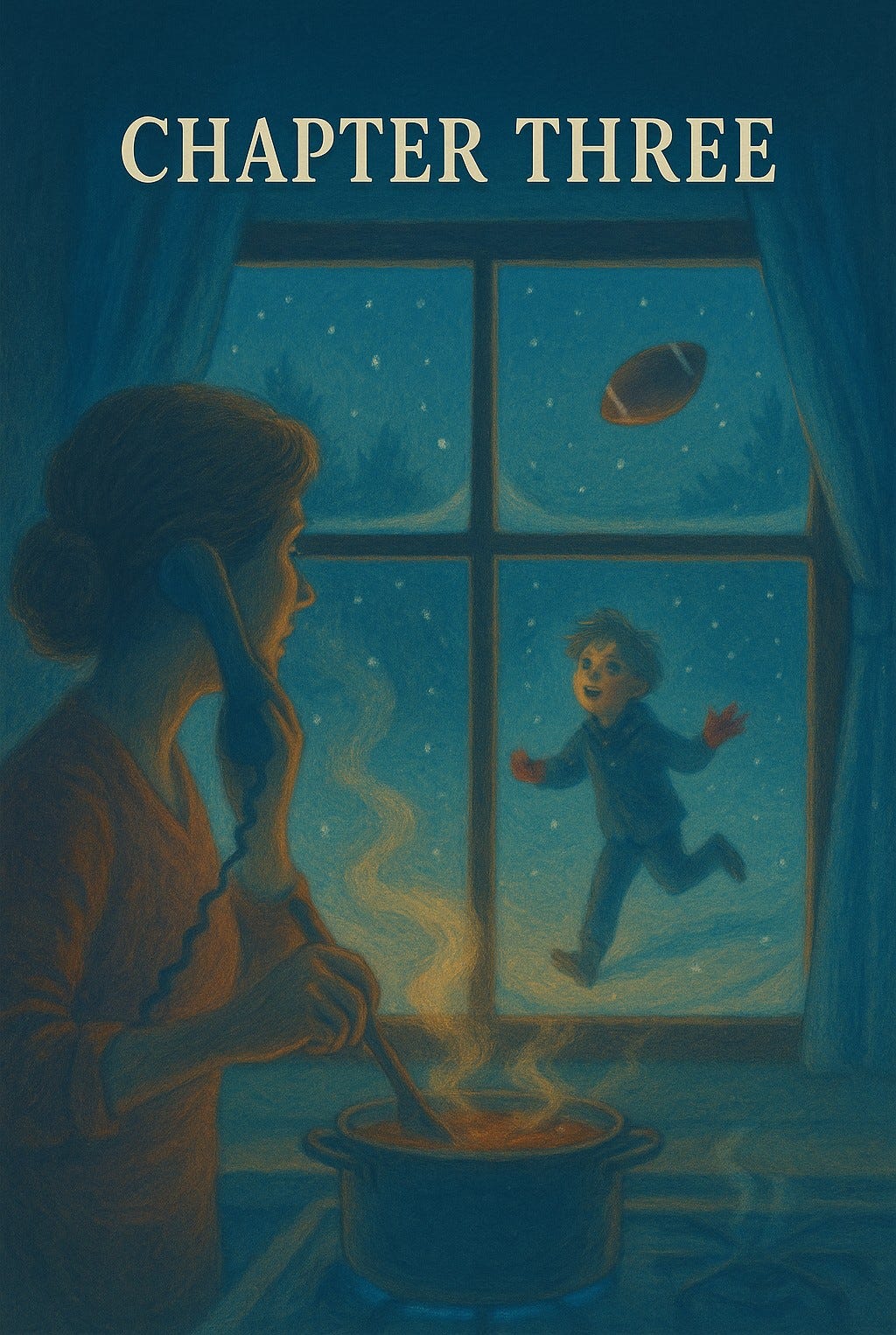
His backpack slumps by the stairs, zippers untouched. He snatches up his football and tugs on his mittens, the same red pair his grandfather gave him a few years ago, soft and worn at the edges, and runs out into the yard.
The ground is frozen stiff, a thin layer of snow sugaring the bare patches of lawn while more drifts down. Nicolas plants his feet like the pros and cradles the ball against his chest.
He takes a breath, then calls out in a steady announcer’s voice:
“Perrin at the line. Dolphins down five. Twenty-five seconds on the clock.”
He crouches low, eyes darting left and right at defenders only he can see.
“There’s the snap! Perrin drops back... he’s looking… looking… he launches it deep!”
He throws the ball as high as he can and sprints across the yard, boots thudding against the white-hard ground. With a final thrust of his feet, arms outstretched, he catches it and continues running.
“It’s caught at the thirty! He’s at the twenty… ten… five… touchdown! The Dolphins have won the Super Bowl!”
He spikes the ball into the snow, both arms raised, laughter bursting from his chest. Then he jogs back to the imaginary huddle for the next play.
Inside the kitchen, his mom stirs a pot of spaghetti sauce with the phone tucked between her shoulder and ear. Her voice is warm, but her eyes are on the window.
“Yeah, we’re all set for Christmas,” she says, watching Nicolas loft the ball into the gray air.
Her friend’s voice crackles faintly on the other end:
“Will Nick be at Daniel’s Christmas party this weekend?”
Her hand stills on the spoon.
“Oh… no,” she says quickly. “We’ve got other plans.”
Outside, Nicolas raises the ball again, mittens flashing red, breath puffing white in the cold. He launches another pass into the waiting sky and chases it like everything depends on his legs reaching it in time.
His mother lingers at the window, pride and worry twisting together in her chest.
“Touchdown! What an incredible pass from Perrin!” Nicolas shouts, celebrating all alone as the snow continues to fall.
That night, Nicolas stands in front of his fabric advent calendar. A bare pine tree stitched across the top, its branches waiting to be filled. Below it, numbered pockets hold small Christmas symbols, a bell, a star, a snowflake, a candy cane, each with a patch of velcro on the back.
He slips his hand into the pocket marked fourteen and pulls out a tiny felt stocking. Carefully, he peels it free, then presses it onto the pine tree above. It sticks with a soft rip of velcro.
The tree is filling now, brighter each night. Nicolas smiles at the sight, then climbs into bed, his mittens resting on the nightstand beside him, fingers curled like they are waiting for morning.
His mom comes in, brushes his hair back with her hand.
“Almost there,” she whispers, glancing at the advent calendar.
“Almost,” Nicolas murmurs, eyes heavy.
She sits on the edge of the bed.
“Hey, can I ask you something?”
“Mm-hm.”
“Has Daniel… or any of the boys… said anything about a Christmas party this weekend?”
Nicolas shrugs. “Nope...” he says, turning to his side. “Daniel and those guys don’t really talk to me anymore.”
“Why not?” she asks softly.
Nicolas shrugs again, pulling the blanket higher under his chin. “Not sure. They’re not really into wrestling and cartoons anymore like me, I guess.” He answers without sadness, like it’s just a fact, and snuggles deeper into his blanket.
She kisses the top of his head.
“I see.” a beat. “Goodnight, sweetheart.”
She stands slowly, her eyes drifting to the mittens on the nightstand, the advent tree on the wall. Her hand lingers on the doorknob longer than it needs to.
When she finally pulls the door shut, her chest aches with the weight of things she can’t fix.
The gymnasium smells like peppermint hand soap and dust.
Not the bad kind of dust, the kind that lives in decoration boxes and the forgotten corners of coat closets, the kind that clings to garland.
It floats in the warm light from the windows, golden and soft, dancing through the air like it’s part of the celebration.
Nicolas walks in holding a drawing of Santa Claus. It’s folded twice and the crayon has smudged near the beard, but he doesn’t care. It’s perfect. Santa’s sleigh has rocket boosters. The reindeer are wearing sunglasses. And if you look close, there’s a trail of stardust behind them that he made with silver glitter glue.
He holds it against his chest like it’s something alive.
The gym is already buzzing. Kids pour in by the dozens - some with jingle bell necklaces, some wearing antlers made from brown construction paper. A few hold holiday crafts like his, the edges bent, colors bright. Teachers are everywhere, waving arms and raising eyebrows, trying to herd energy into something vaguely organized.
Paper snowflakes hang from the ceiling. Streamers flutter on the walls. The speaker in the corner plays a slightly-too-slow version of “Jingle Bells,” crackling once as if even it knows how old it is.
Nicolas smiles at everything. He can feel the excitement in his fingers. The air feels fizzy. Like it’s full of invisible bells.
He walks with his class to their spot on the floor and sits crisscross applesauce, knees bumping gently against the kids beside him. The floor is cold through his jeans, but he doesn’t mind. Not today. Not on the last day before Christmas break.
A teacher hands out song sheets as someone sneezes. Someone else giggles. But Nicolas just stares up at the lights on the ceiling, where a string of tinsel catches the sun and sends little stars across the gym floor.
He holds his drawing close, closes his eyes for a second, and whispers something only the paper can hear. Then he looks up, ready.
A hush falls, slow and soft.
One of the music teachers steps forward and lifts her arm. The lights above the gym flicker gently as the last few voices quiet down. A boy near the front coughs once. Then silence.
A click. A crackle. Then the speaker begins to play the opening notes of Silent Night.
Nicolas doesn’t need the song sheet in his lap. He already knows every word. Every note. But he holds it carefully, like it’s part of a ceremony - something sacred you don’t rush.
He takes a small breath. Just enough to steady himself.
And sings.
The words fall from his lips like snowflakes - slow, deliberate, soft around the edges.
“All is calm… all is bright…”
Around him, other voices join in, but he doesn’t hear them all. Not really. The sound is there - filling the room - but his focus is somewhere else entirely.
It’s the light reflecting off the tinsel. The way it catches in slow, golden pulses.
The soft rustle of paper snowflakes swaying from the rafters.
Bells that someone shakes - gently, almost shyly - near the back of the room.
It’s the warm bloom in his chest. Like something is lighting up from the inside. Like the song is singing through him.
He doesn’t understand it - but he doesn’t need to. He just knows this is real. This is good. This is his.
A smile forms, quiet and steady. The gym fades. The voices, the room, even the cold beneath him… they all slip away like a coat falling from his shoulders.
And what’s left is that hum. That stillness. That glow.
He is part of something.
Something vast and unseen, but close enough to feel.
And in the center of it all, a boy with his glittery Santa drawing pressed into his lap sings softly under a ceiling of paper snowflakes - heart wide open, eyes bright, and wonder alive in every breath.
The second verse begins.
“All is calm… all is bright…”
Nicolas’s voice is quiet, but steady. The notes rest on his tongue like something familiar and treasured. His hands sit folded in his lap, fingers loosely intertwined over the wrinkled edge of his Santa drawing.
And for a moment, it’s just the song. The hum in his chest. The warmth rising like a secret between his ribs.
Overhead, the HVAC clinks on, and the paper snowflakes stir. Nicolas glances to the side.
Just for a second.
Daniel, the boy beside him, is mouthing the words without sound, his eyes half-lidded. He leans backward slightly, rocking side to side like he’s making fun of a lullaby. His paper antlers are crumpled.
Nicolas looks further back. Two girls are giggling behind their song sheets. One pretends to fall asleep, her head slumping onto her friend’s shoulder.
A boy with his hoodie pulled halfway up flips a paper snowflake in slow circles against the floor.
The song plays on. But it sounds different now. Not bad. Just… thinner.
Nicolas turns forward again. He doesn’t say anything. Doesn’t stop singing. But his voice is quieter now. Like maybe the moment needs protecting.
He shifts his drawing in his lap, smoothing the fold across Santa’s rocket sleigh.
He keeps his eyes fixed on the music teacher as she coaxes the scattered voices into something resembling a song. She glances at Nicolas and, with a smile as soft as snowfall, gives the slightest nod. His shoulders ease; the weight slips. In that glance, an unspoken pact: she, too, still walks inside the hush and glow. For a heartbeat, he isn’t alone.
He keeps singing. But he is acutely aware that something has shifted.
Something he can’t name.
Like a window cracked open in the middle of a warm room.
And the hum… it’s still there. Just not as loud.
The song ends, not all at once, but like a dream fading.
The last few notes drift into the air and disappear somewhere near the rafters.
Applause rises - loose and uneven. A few kids clap with both hands. Some just slap their palms on their knees. One boy yells, “We’re free!” and gets a pointed look from a teacher.
Nicolas doesn’t move right away. He’s still sitting crisscross on the floor, hands folded over the drawing in his lap.
The lights blink above him - soft gold, steady red. The paper snowflakes twist slowly in the heat from the vents.
He looks down. The drawing of Santa Claus is bent slightly at the corners now. The reindeer’s antlers are creased. And near the bottom, where the trail of glitter glue once shimmered like a comet…
Some of the sparkle is gone.
Tiny flecks of silver have flaked loose, scattering across his lap and onto the gym floor.
He stares at them for a second. Then opens his hand.
With the other, he brushes the loose glitter gently - carefully - into his palm.
It’s clumsy; most of it falls away, but a few bits land, tiny stars, glimmering dust.
He closes his fingers around them and holds them tight.
Around him, the gym swells with motion - kids laughing, teachers calling out reminders, the scrape of benches and the creak of the loudspeaker starting up again.
But Nicolas doesn’t rush.
He folds the drawing once, then again, and slips it carefully into the inside pocket of his coat.
Then he rises.
The glitter rests in his hand - warm now, from the heat of his skin.
He doesn’t open his fingers. He just lets it stay there, a quiet secret.
As he walks out of the gym, a snowflake decoration flutters from the ceiling and brushes his shoulder.
The hallway is full of noise again - zippers, boots squeaking, lockers slamming open and shut. A teacher somewhere reminds everyone to pack up their crafts. Someone is laughing. Someone’s singing.
But Nicolas barely hears it.
He walks a little behind the others. Not because he’s tired. Just because… he wants to feel the quiet a little longer.
He shifts the drawing in his coat. Presses it flat with his hand.
His other hand is still closed.
He walks slowly, carefully, like if he moves too fast, the magic might spill.
The door to his classroom is open. A coat hook waits with his name on it.
“See you tomorrow, Daniel!” someone shouts across the hallway.
Nicolas is unfazed.
He steps inside. He closes his eyes for a second. Breathes in the smell of paper and pine. Feels the drawing in his coat. Feels the glitter in his hand.
And smiles. Small. Still. Certain.
Then he opens his hand - just a little - and lets the silver fall gently into the pocket of his coat, so he can carry the wonder just a little longer.
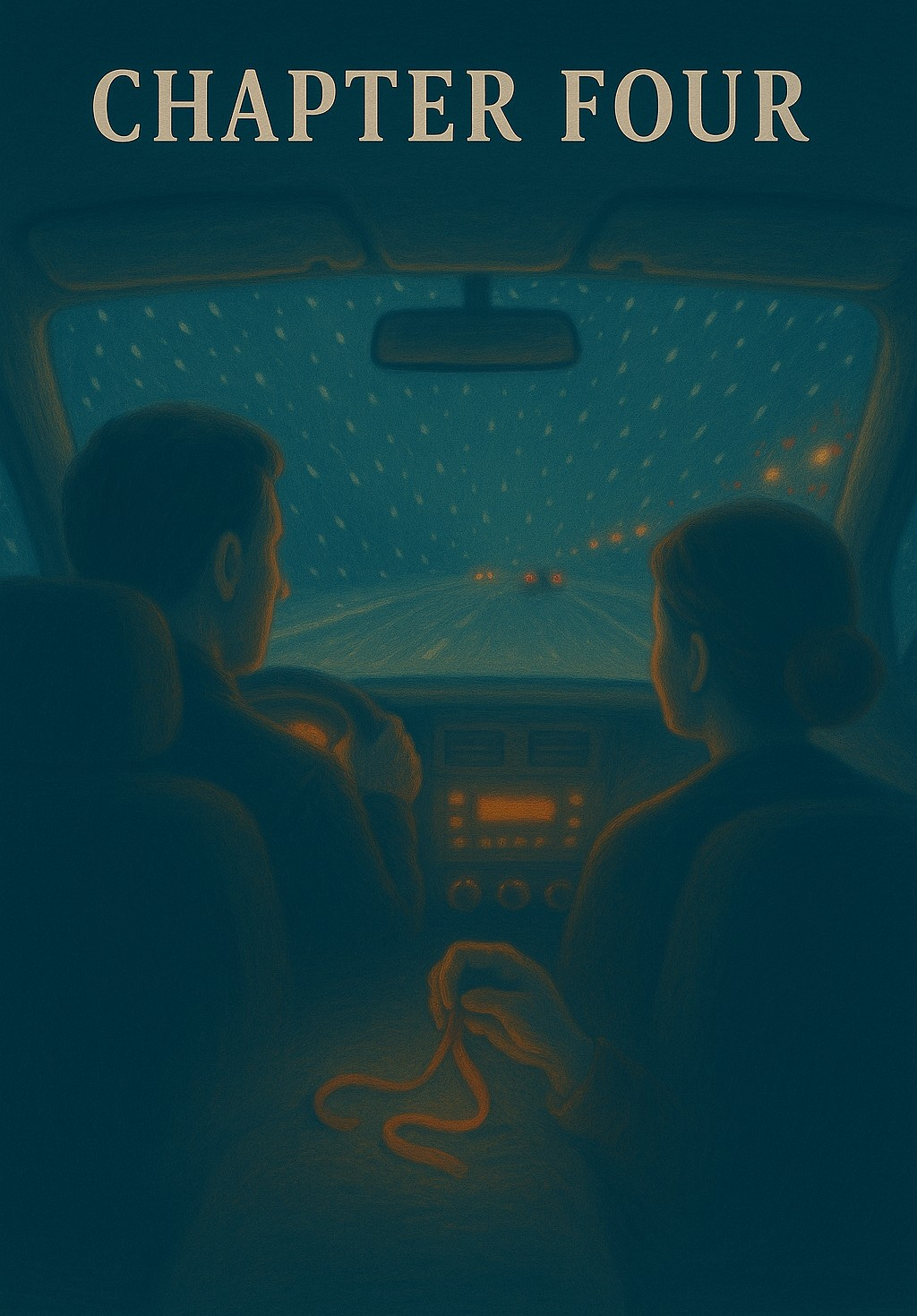
The highway hummed beneath them, steady and low, a sound that seemed to live in the bones if you listened long enough. Snowflakes spilled through the headlights in endless sheets, bright for an instant, then gone. The windshield wipers moved in their slow arc, leaving streaks that blurred the world beyond into long smears of red and white.
Every so often, a cluster of houses appeared, glowing with colored bulbs or single candles in the windows. Then the road swallowed them again, giving way to wide stretches of dark woods. The ride home from her aunt’s house was nearly an hour, most of it a rhythm of light and absence, color and shadow.
In the back seat, Eve sat curled toward the door. Her coat hung half-open, her scarf loose, one mitten forgotten on her lap. In her palm, a ribbon from one of her gifts coiled and uncoiled. She wound it tight until her finger flushed red, then let it slip loose, repeating the motion as if her hands were keeping time with her thoughts.
The car was warm, the heater blowing in steady breaths. The windows fogged in wide halos, then cleared, over and over, as though the car itself was breathing along with them. From the backseat, the scent of garlic and tomato sauce slipped from tinfoil-topped containers, mingling with the sweetness of cookies in a tin. And beneath it all lingered the faintest trace of pine and cinnamon, a quiet reminder that another Christmas Eve had come and gone.
Her parents spoke softly in the front. She couldn’t make out all the words, but she knew the cadences by heart, the way her dad leaned forward, turning his head to the side, before changing lanes, the way her mom’s laugh slid out like a secret when he said something only for her.
For a long while, Eve said nothing. She let her gaze drift to the side window, where the snow looked less like falling and more like rising, like they were driving through stars instead of weather.
Finally she broke the silence. “Mom?”
Her voice wasn’t loud, but it lifted both their heads.
Her mother turned in her seat, half-twisted toward her, her face caught in the glow of the dashboard. A strand of hair had slipped loose across her cheek. Her eyes were soft, waiting.
Eve looked at her for a moment, then back to the window. The snow tumbled upward in the glass. She said it plainly, like naming the date or telling the time:
“I know Santa isn’t real.”
The words hung in the air, quiet and enormous.
Her father’s hands tightened on the wheel, the tendons in his wrists standing out. He didn’t speak.
Her mother’s lips parted, then closed again. She drew in a breath that began like laughter but left her as a sigh instead. In the dim light her eyes shone, too wet to hide.
“Oh, honey,” she said softly. Not the kind of oh that denied or argued. Just the kind that meant I hear you.
Eve waited. She thought she’d feel something collapse inside her, sadness, maybe, or the hollow everyone always spoke of when magic was gone. For an instant, she felt a sting in her chest, quick and sharp. But then it slipped away. What filled her instead was something steadier.
She sat taller, shoulders pressed against the seat. “I figured it out,” she said, and the words carried pride.
The memory came back sharp, as though her mind had stored it away on purpose.
Santa had been planted in Nonna’s armchair, the red suit stretched snug across his belly, the beard puffed out like a pillow. His laugh filled the room too big, booming and bright, echoing louder than it needed to.
When Eve stepped forward for her turn, she didn’t bounce like the younger cousins. She moved smoothly, almost serious, like she was walking into a test she meant to pass.
Santa patted his knee. “Come here, Eve!”
She climbed up carefully, folding her hands in her lap. Her head tilted, her eyes narrowing, not dazzled, not impressed, just curious.
“Did you get my letter?” she asked.
The question rippled across the room, too small for anyone else to notice, but sharp in its aim.
Santa’s laugh burst out instantly, practiced. “Well of course!” he boomed.
But Eve hadn’t written one this year. Not a list. Not a note. Not even a quick hello. The smile that tugged at her lips was invisible to the crowd but undeniable to her.
The camera flashed, freezing the moment for the family photo album, but the real picture was tucked away inside Eve’s mind, a piece of evidence saved for later.
The ribbon tightened around her finger in the car until the skin blushed deep pink. Ahead, the taillights of other cars stretched like a string of red beads across the dark highway.
“He said he got my letter,” she murmured. Triumph edged her voice. “But I didn’t write one.”
Her mother turned halfway in her seat, lips pressed tight, her eyes wet though she tried to steady them. Her father let out a sound low in his chest, half breath, half laugh, and swallowed it before it escaped. He reached to adjust the heater, then didn’t, his hand hovering a second in midair.
The silence that followed wasn’t empty. It was thick, like the kitchen air just before the oven door opens. Eve was warmed by the knowledge that the first crack in the story had been hers to find.
Santa’s lap wasn’t the throne of wonder it used to be. Eve sat neatly, hands folded, her eyes roaming the room like she was counting pieces on a game board.
She counted.
Uncle Tony by the fireplace, scarf thrown over his shoulder, gesturing like a man telling a fish story. Check.
Uncle Sal, laughing and arguing about whose car would be stuck in the drive, jangling his keys like proof. Check.
Older cousins, lined along the hallway arch, pretending to be too old to care while angling for the best view. Check.
Her father at the kitchen doorway, her mother right beside him, both smiling wider than the moment called for. Check and check.
Every man accounted for. Not one missing.
A frown pinched her face, brief as a heartbeat, before she smoothed it away. Maybe the trick was cleverer than she’d thought.
Then Santa shifted. A glimpse of boots beneath the red pants, black, heavy, scuffed, laces shoved into the tops instead of tied. White salt stains catching the light. One eyelet showed a dot of bare metal, like a tiny silver wink. She noticed, but didn’t claim it as proof. Just another detail, saved like a bead in a pocket.
“Thank you,” she said sweetly when he pressed a box into her hands. She felt the ridges of the cardboard through the paper. She smiled for the camera again, but her mind was still counting.
On her way back to the couch she passed Aunt Jan, who bent to kiss her head; the smell of her perfume, powdery roses, lingered a second around Eve’s cheek. She sat, smoothing her skirt, and laid the gift in her lap like evidence waiting its turn.
Back in the car, Eve dropped her gaze to her own boots, edges white with dried salt. Melted snow pooled in shallow puddles on the mat. She nudged one toe against the other, then leaned forward, her voice low but certain.
“I counted everyone. All the uncles. Dad. Even my cousins. Nobody was missing.”
Her father’s eyes flicked to the mirror, then back to the road. Her mother turned in her seat, her mouth pulled into a thin smile.
“You really were paying attention,” she said softly.
Eve let out a single breath of laughter through her nose, pleased. “Of course I was.”
Streetlamps passed overhead, spilling their glow through the windows in bursts. Each one lit her reflection for a moment before sliding past, like a series of brief acknowledgments.
The box Santa had given her earlier had felt solid, sharp-edged beneath the paper. She’d noticed the design as the flashbulb went off: white paper printed with candy canes and green sprigs of holly.
At the time, it hadn’t meant much. Another tag scrawled From Santa.
But later, after dessert plates had been stacked in the sink and laughter had softened into smaller pockets around the room, she saw it again.
Her mother placed a gift into Grandpa’s lap.
Eve froze. The same white paper. The same candy canes leaning at the same angle. The same green holly leaves printed across the same slant.
Her mother’s tongue pressed into her cheek as she smoothed the seam flat with her thumb, just as she always did when wrapping.
Eve sat straighter, her chest lifting. Her heart didn’t drop. It leapt. The Santa paper and the Grandpa paper were one and the same. Another piece fit cleanly into place.
The ribbon slipped loose from her pocket in the car. She looped it back around her finger, watching the deep groove it left in her skin.
“The paper matched,” she said suddenly. Her voice carried no sorrow, only the pride of a detective revealing evidence. “Santa’s gift to me was wrapped in the same paper Mom used for Grandpa’s.”
Her mother’s breath escaped in a sound caught between laugh and sigh. She didn’t speak right away.
“You noticed that?” she asked finally, her face catching the glow of the dash.
Eve nodded. Her eyes stayed on the snowfall racing toward them. “Yeah.”
Her father’s hands eased on the wheel. He said nothing, but in the mirror she caught the faintest pull of his mouth, pride hidden where he thought she wouldn’t see.
Eve pressed back into her seat. Outside, the highway looked the same, dark stretches, endless snow, but inside she felt older, as though she had passed a test no one knew she was taking.
The house was exhaling by the time she bent to pull on her boots. Voices called across rooms about missing gloves. Plastic containers snapped shut in the kitchen. The scent of coffee mingled with the sweet smoke of a candle nearly burned down.
And there they were.
Black work boots tucked against the wall. Heavy, scuffed, laces shoved down into the tops. A crust of fake snow clinging stubbornly at the seams.
Her mitten stilled midair. She had seen them earlier beneath the suit.
A moment later Marco appeared, his hair damp, his cheeks flushed. He bent, scooped the boots up by their tongues, gave them a shake, and walked back to the kitchen where her cousin was waiting.
Eve’s eyes followed him, unwavering.
The puzzle locked.
Not an uncle. Not her dad. Marco. Her cousin’s boyfriend.
The final piece belonged to her.
She zipped her coat and stood, taller than she had when she’d walked in. Not disappointed. Not heartbroken. Triumphant.
She had solved it.
The tires thrummed beneath them, the heater purred. Snow poured through the headlights in restless streaks. The heater blew against Eve’s legs, warm enough to make her drowsy, though her mind was alive and sharp.
She pressed her palms together, still damp from melted snow. For a long stretch she said nothing. Then, quietly, she broke the silence.
“The boots were Marco’s.”
Her father’s eyes flicked to her in the mirror, her mother twisting in her seat. Neither looked surprised, but something passed between them, sorrow and pride, tangled.
“I saw him pick them up when we were leaving,” Eve said. Her voice was calm, even. “The fake snow was still on them. It was him. I knew it.”
Her father turned back to the road, jaw tight. His thumb worried the seam on the steering wheel, a habit Eve knew meant he was holding words back. Her mother’s lips trembled into a smile that carried both ache and admiration.
The silence thickened again, but this time Eve welcomed it. She leaned into it, let it surround her like a blanket.
“Do you want to talk about it?” her mother asked.
Eve shook her head, her eyes fixed on the glass, where the world outside hurried past.
The ache came briefly, sharp, fleeting, like a note lingering after a song ends. Then her mind unspooled the night, filling the space.
Her cousins shrieking, voices loud enough to rattle the picture frames. Wrapping paper flying in red and green storms, ribbons curling across the carpet like vines. The sound of tape being found and lost and found again, the squeak of the dispenser like a small bird. Her aunts spilling from the kitchen, flushed, one of them laughing so hard she bent double, dabbing tears with a dish towel. A smear of sauce shining on Uncle Tony’s cheek. A baby’s sock abandoned under the coffee table like a tiny flag.
The smells returned in waves, garlic melting in oil, tomatoes simmering thick on the stove, powdered sugar dusting the air above a tray of cannoli. The clove-prickle of mulled wine. Even the sweetness of chocolate still clung to her tongue, the heavy, satisfying kind that made the whole table hush for a beat.
Her uncles in the hallway, arms loaded with tubs, shouting and laughing as they tried to wedge leftovers into the fridge. Someone sneaking a meatball, grinning when caught, forgiven with a wave of a spoon and a “go on, then.” The scrape of chairs, the clink of forks on plates, the chorus of “Did you try the Nutella Christmas tree?” passing from room to room like a tide.
And her parents, her father balancing a plate while his arm circled her mother’s shoulders. Her mother leaning into him, her face tired but luminous, eyes glowing warmer than the tree. His hand squeezed her shoulder without either of them looking; hers found his wrist and rested there like it had been made to fit. That image burned brightest, the anchor of it all.
Eve closed her eyes and held it, let it fill her until the ache dissolved. Warmth rose in its place, rich and steady, spreading until she felt taller than the seat could hold. She pictured herself next year handing out the gifts, reading the tags without mixing them up, taping the seams straight, sneaking a meatball and getting away with it because now she’d be in on the joke. The thought made her smile.
She opened her eyes to the blur of taillights stretching ahead. The snow drifted thick and slow now, the kind that settles and stays. In the glass, her reflection looked back, familiar, but older, a certainty added around the eyes.
Her mother’s hand reached back between the seats. Eve lifted her mittened fingers and tapped it three times: one, two, three. Their secret code.
The headlights carved a bright tunnel into the night. The car moved forward, steady, carrying them home.
Eve sat upright, her smile steady, the warmth of the night burning quietly inside her.
The mall was overflowing with Christmas, a storm of light and sound that swallowed the air.
Lights looped across railings three stories high, strands of gold and green spilling over the edges like shimmering ivy. Garlands hung heavy between columns, shedding faint glitter when someone brushed past. A thousand bulbs blinked at once, chasing each other along banisters and pillars, reflecting in the polished tile like scattered stars.
Nicolas didn’t see the chaos; his red mittens swung from their clips as he moved, eyes darting from shimmer to shimmer as though each one carried a secret meant only for him.
He liked it better this way. When he looked too closely, the mall felt crowded and tired, people rushing, bumping, sighing. But if he let his mind tilt just slightly, everything bent into magic. The lights weren’t bulbs, they were stars. The noise wasn’t irritation, it was proof the world was alive.
The fountain at the center had been drained and filled with a mound of fake snow, the kind that shone too white under fluorescent lights, too perfect to fool anyone but a child. A plastic sleigh perched on top, frozen in mid-flight, its runners gleaming like steel blades. Nicolas stopped to look at it for a moment. He knew it wasn’t real, he could see the wires, the molded plastic snow, the reindeer’s eyes that were nothing but glass marbles set too deep. But that didn’t matter. It was a replica of a dream, and that was enough.
The air itself was a chorus of smells: cinnamon from the pretzel stand, buttery popcorn from the kiosk, sharp perfume leaking from a department store doorway. Somewhere, a blender whirred, mixing fruit into foam, its buzz crawling under the carols that dripped endlessly from the ceiling speakers. Every sound layered onto the next: the shuffle of boots on tile, the squeak of stroller wheels, the rise and fall of voices, the constant bells of cash registers and credit card readers beeping approval.
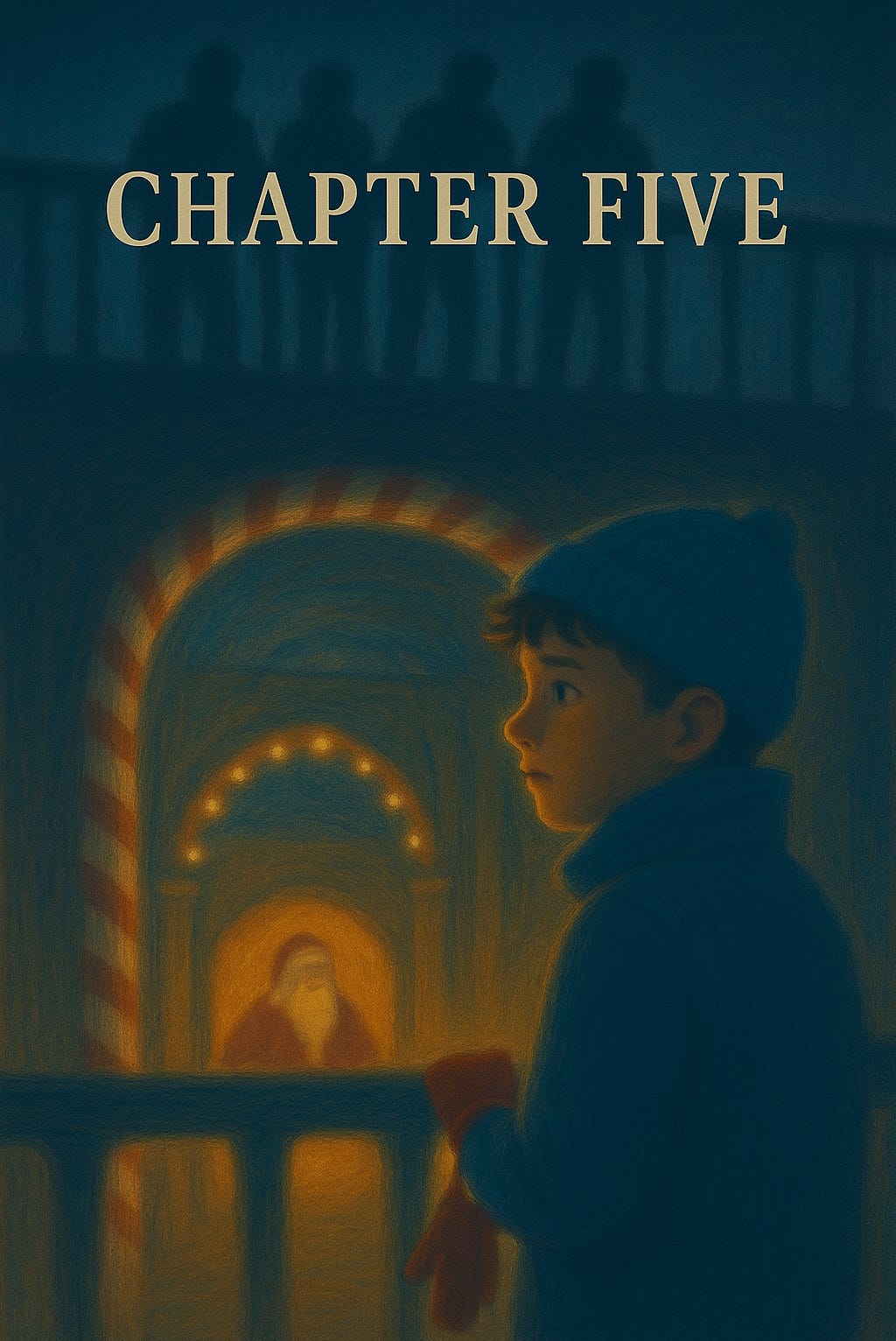
But in the middle of it all, Santa’s workshop glowed, a little world unto itself.
An archway of candy canes leaned above a red carpet, its edges dusted with more plastic snow. Stiff-necked, glossy-eyed reindeer stretched toward the ceiling as if caught mid-leap. Oversized ornaments dangled from wires, swaying faintly whenever a draft wandered through. And at the center of it all sat Santa, his red suit brighter than anything else in sight, his white gloves folded in his lap, his beard shining under the glow of a spotlight that hummed faintly when it flickered.
Nicolas, now twelve, bounced in place, his chest humming with that familiar fizzy anticipation, as if the whole world was charged with electricity.
Sometimes he felt like the only one who still carried that hum. Other kids his age wanted video games, sneakers, afternoons at the mall without their parents. He wanted this. And he didn’t even mind that it set him apart. At least, he told himself he didn’t.
The line stretched back farther than he could see, a river of people inching forward. Parents shifted shopping bags from one arm to the other, children whining and tugging at their sleeves. Babies cried, coats slipped, a father balanced three cups of coffee like trophies, steam curling up from the lids. But Nicolas saw none of that. He just saw the magic. He saw the elves in their green vests, the steady flash of the camera, the reindeer poised for flight. Every piece of it was alive, just waiting for him to notice.
Lucy sighed beside him, her arms crossed tight. She leaned toward their mom, her braid falling across her shoulder. “Do we really have to do this? We’re too old for Santa pictures.”
Their mom smoothed Nicolas’s hat, brushing a bit of hair from his forehead. “Lucy,” she said softly, her voice full of gentle patience, “your brother still believes.”
Lucy rolled her eyes, but didn’t argue. Instead, she looked up at the candy-cane arch. One of the canes leaned slightly off-center, its curve not quite matching the rest.
“That one’s crooked,” she muttered.
Nicolas studied it, tilting his head. “It’s supposed to be,” he said with certainty, as if it was a known fact. “Candy canes are like compasses. The red stripe always leans toward the North Pole. If it stood straight, Santa wouldn’t know which way to go when he leaves.”
Lucy’s mouth twitched, just barely. She turned her head, pretending to look at a gingerbread stand, but Nicolas knew she was smiling.
Lucy tried to poke holes, but the holes only made his light shine through brighter. For a second, she even seemed to enjoy it.
The line crept forward. At the front, another family stepped onto the red carpet. One of the elves bent low, leaned close to Santa, and whispered before pulling back.
“See?” Lucy nudged Nicolas. “She tells him their names. That’s how he knows them.”
Nicolas leaned closer, his voice low and serious. “She’s not telling him names. She’s telling him how bright their glow is. Elves can see it... the glow kids have when they still believe. Santa already knows their names. He just needs to know how strong the glow is.”
He wanted it to be true so badly that it felt true. Sometimes he wondered if that was what belief really was, not proof, not evidence, but the way your heart tilted toward the story instead of away from it.
Lucy’s eyes flicked back to the chair, following the elf, considering. For a second, her brow softened. The flicker of something in her eyes, a question she didn’t voice, was enough. He saw it. And it was all he needed to keep going.
Another shuffle forward. Two toddlers clutched jingle-bell necklaces that rattled with every step. Santa’s laugh boomed as they scrambled into his lap, the bells jangling in time with his “Ho ho ho!”
Lucy tilted her head toward Nicolas again, her voice sly but quiet. “If this is the real Santa, then who was the one outside the toy shop last week? Or the grocery store? There’s too many.”
Nicolas didn’t flinch. “Those aren’t Santas. They’re observers. He sends them out to see who still notices him. Who waves, who smiles. And then they bring it back to him, so he always knows who still believes.”
Lucy let out a laugh she hadn’t meant to, covering her mouth with her glove. She shook her head, but her eyes shone brighter.
The line shuffled again. Nicolas craned his neck toward the escalator... and froze.
Three boys walked across the second-floor balcony, they were loud, careless, their laughter spilling over the railing like stones dropped into a pond. Two of them had once been his friends, though they hadn’t spoken to him in over a year.
They’d stopped calling his house. Stopped waiting for him at recess. One day he was part of their games, and the next he wasn’t, and no one had explained why. He still saw them in the hallways at school, always together, always laughing. And now here they were, bigger somehow, older, arms full of shopping bags, looking like they belonged in a world he hadn’t been invited into.
They leaned on the railing, shoving each other, pointing at the sneaker store below. They didn’t glance once at Santa’s glowing archway, or the children bouncing in line, not even the reindeer poised mid-flight.
And why would they? They were done with this part of childhood. They had peeled it off like an old coat, while Nicolas still clung to it with both hands. To them, he’d look like a baby here, waiting in line with his mom, mittens dangling from his sleeves, eyes shining like he couldn’t help himself. If they saw him, they’d laugh. They wouldn’t even mean to be cruel, but they would laugh. And that would be worse.
A cold knot formed in his stomach. He ducked behind a marble column, pressing his shoulder to the stone. His heart thudded so loudly he was sure Lucy could hear it. For a moment, he wished he could vanish into the floor.
It wasn’t just embarrassment. It was the fear of being found out, that the part of him that still believed, the part that whispered to the snow and spun stories out of crooked candy canes, would be dragged into the open and torn apart. If they saw him like this, if they pointed, it would be ruined. And he couldn’t afford to lose it. Not this. Not the one thing that still made him feel lit up inside.
The boys’ laughter trailed off as they disappeared toward the escalator. The sound dissolved back into the carols and chatter of the mall, but the echo of it stayed in Nicolas’s chest.
He pressed his back harder to the column, feeling the chill of the stone seep into him, until the line nudged forward again. Slowly, he stepped out from hiding. The lights shimmered off the polished floor, tugging him back into their spell, urging him forward.
Lucy tugged her glove higher, nodding toward another elf scribbling on a clipboard. “She’s not doing anything special. She’s just keeping the order.”
Nicolas grinned, leaning closer. “Not just the order. She’s writing down the things kids say in line in case one of them is too shy to ask for what they really want. Elves hear those, and Santa gets them on the list.”
Lucy burst into laughter, the kind that bubbled up and shook her shoulders. She shook her head again, but she couldn’t hide the smile spreading across her face.
That smile was everything. He wanted to hold it, keep it, tuck it away like the glitter from his drawing at school. If Lucy could smile at his stories, maybe she hadn’t left the magic behind completely. Maybe no one ever really did.
And then, suddenly, it was their turn.
The world seemed to slow, the chaos of the mall fading into a soft hum. Nicolas stepped forward onto the red carpet, the plush fabric giving slightly under his weight. The lights seemed to get brighter. The air smelled of gingerbread.
He stood beside Santa Claus, close enough to feel the warmth of his sleeve, close enough to smell the faint peppermint woven into the fabric.
Santa leaned slightly, his voice warm and low, the voice Nicolas carried in the back of his mind all year. “And what would you like for Christmas, young man?”
Nicolas swallowed, his heart pounding against his ribs. He thought of the boys on the balcony, of their laughter echoing down like a reminder that he didn’t belong with them anymore. He thought of Lucy’s smirk, her rolling eyes, the way she tried so hard to convince herself the magic wasn’t real.
He leaned closer, his voice almost breaking with how small it was. “Can you make Lucy believe again?”
Santa’s eyes flickered. His blue eyes, magnified by his glasses, were kind, but also surprised. He didn’t speak. He just looked at Nicolas, and in that look, Nicolas felt something he hadn’t realized he was desperate for: to be understood.
It wasn’t just about Lucy. It was about not wanting to be the only one left. About wanting someone else to feel what he felt, the buzz in his chest when the lights blinked, the way the world seemed to hum on nights like this. He wanted to share it. He wanted his sister to see it too.
Santa’s gloved hand came down gently on his shoulder, steady and firm, as though anchoring him in place. Nicolas’s throat tightened.
For parents watching, it would look like nothing more than a boy whispering into Santa’s ear, maybe too shy to say what toy he wanted out loud. But for Nicolas, and for anyone who had ever wished they could hold their child’s wonder a little longer, it was truly the only thing he wanted.
Nicolas hesitated, then added quickly, his voice trembling into something almost hopeful: “Oh, and if you can… could you make it snow soon?”
From behind the camera, their mom chuckled softly, breaking the hush. “Nic, it’s not even November yet.”
Lucy smirked, shaking her head as the flash went off.
They filed out, weaving through the crowd and spilling into the night. The cold hit immediately, sharp and clear. The lamps in the parking lot burned yellow against the sky, wide halos in the dark. Their boots clicked against the pavement as they crossed to the car, bags swinging from their arms.
Inside the car, the heater hummed, a soft, steady sound. Their breath fogged the windows until they cleared again. The mall lights shrank behind them, swallowed by the dark.
Nicolas leaned his forehead to the glass, watching the sky. He was still carrying the weight of the moment, the way Santa’s hand had pressed on his shoulder like a promise.
And then, a single snowflake caught in the beam of the headlights, tumbling once before melting away.
Then another.
And another.
Until the road ahead glittered with a slow, steady fall, the first snow of the season, drifting down like it had been waiting for this exact moment.
Nicolas’s chest leapt. He pressed his palm to the window, making a small circle of clear glass in the fog, a perfect frame for the falling snow. His heart swelled until it felt too big to hold.
“Well, would you look at that,” their mom murmured. Her voice soft, as though she too, felt the timing was almost too perfect.
Lucy turned toward the glass. The flakes spun in the headlights, bright as stars. For a second, she was still, her lips parted, her eyes wide.
And then she whispered it. So soft he almost didn’t catch it.
“Hi, snow.”
Nicolas froze, breath caught in his throat. His whole body hummed. For one heartbeat, he wasn’t alone. For one heartbeat, she believed too.
He turned toward her, desperate to see that look again.
But Lucy was already gone. She had pulled her hood up, slid her headphones over her ears, and leaned back against the seat, her gaze sinking into the glow of her phone. Not a word. Not a glance.
The ache of it stung Nicolas’s chest, but he knew she’d felt it, even if only for a breath.
He pressed his hand against the cold glass, as if he could hold the moment there. But it slipped anyway. And then, unexpectedly, tears came, flowing, faster than he could stop them.
They weren’t for himself.
He wept for the children who forgot too soon, who traded their glow for sneakers and screens and laughter that never reached their eyes. He wept for his old friends, who once built forts and chased snowflakes with him, but now walked past the magic without even seeing it.
And most of all, he wept for Lucy.
Because she had believed. He’d felt it when she whispered to the snow, when her eyes had gone wide and soft and shining. For one heartbeat, she’d been there with him, inside the story. And then, just as quickly, she was gone. Vanished into the glow of a phone that could never glow the way the world did.
The unbearable part wasn’t that she no longer believed. It was knowing the magic was still inside her. Nicolas was certain of it. He believed it lived in everyone, that quiet hum, that warmth in the chest that could make the ordinary extraordinary. But the world didn’t make space for it. People were told to grow up, to move faster, to look down at lists and phones instead of up at the stars. And slowly, without meaning to, they stopped looking for it.
But the magic wasn’t gone. It was only buried. Waiting.
And Nicolas’s tears slid down his cheeks, like the whole world was mourning through him, mourning for the wonder still hidden inside every heart, a wonder most would never uncover again.
And in that truth, a shiver passed through him: because he knew that one day, unless he fought with everything he had, even he would lose it too... and he might not even realize it was gone, until it was too late.
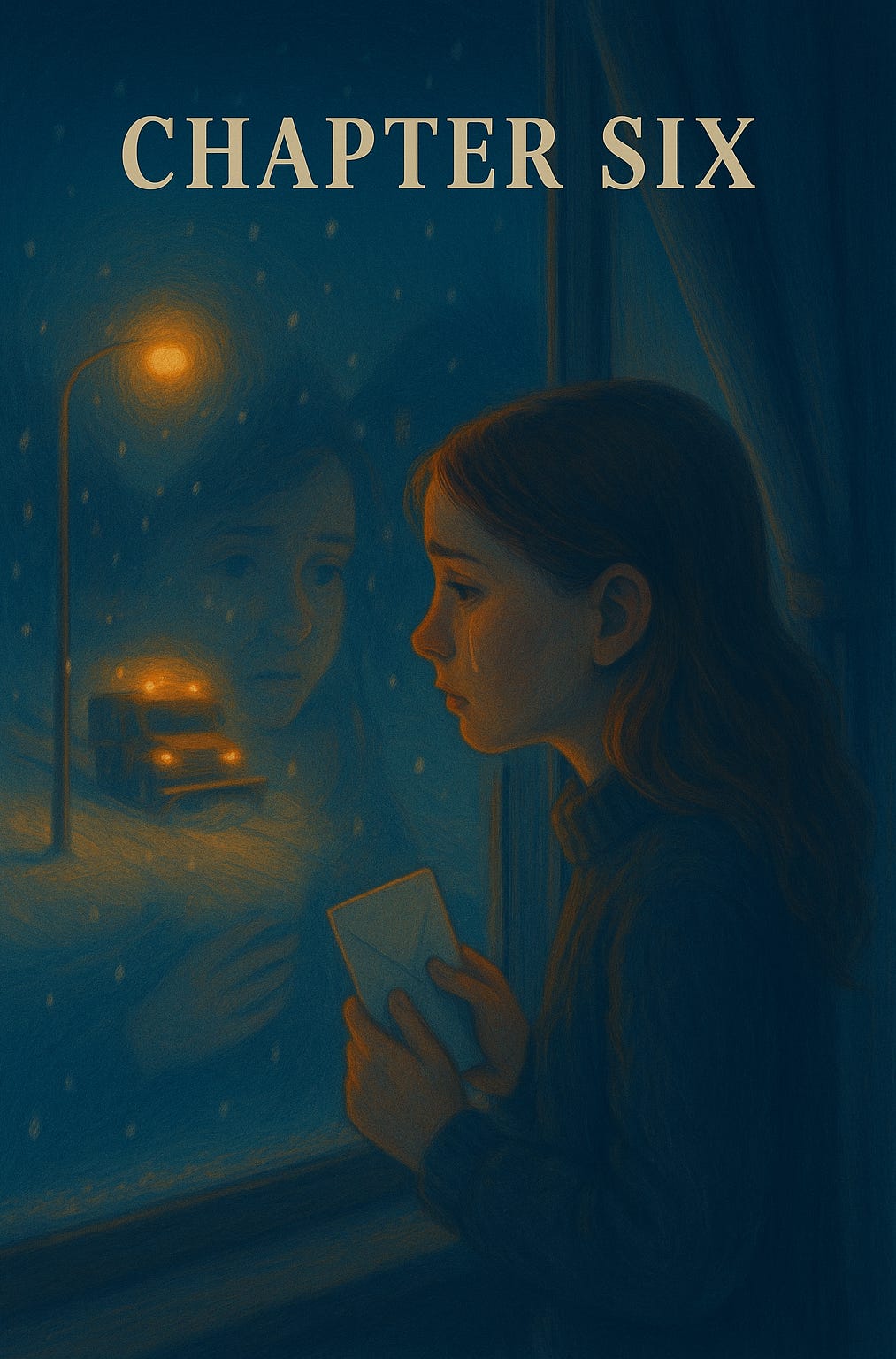
The classroom hums with pre-winter break restlessness. Backpacks slump against chair legs like they’re as tired as everyone else. Mrs. Delaney claps her hands once to quiet everyone.
“For your holiday assignment,” she says, “you’re going to write a letter. To anyone in the world. Real, fictional, alive, or long gone. Make it personal. Make it honest.”
The room groans. Someone mutters boring as a boy in the back asks if he can write to the cafeteria lady and complain about pizza Fridays. Laughter rolls and fades. Pencil tips tap. A radiator rattles once in the corner and then settles.
Eve sits tall in her seat. She likes assignments like this, crisp edges, clear rules, the quiet promise that if you put the right words in the right places, something good will happen.
“Pick someone who matters. And tell them something you wouldn’t say out loud,” Mrs. Delaney declares.
Eve leans toward her best friend, Emma. “Harry Styles,” she says, soft but certain.
Emma grins. “Obviously.”
“It’s for a grade,” Eve says, already flushing. “Not because he’s...”
“...gorgeous,” Emma finishes, delighted.
Eve rolls her eyes, but she can’t help the small smile. It’s not just that he’s gorgeous. It’s the way he looks at crowds like he actually sees people. It’s the way the songs sit right in the middle of the warmth and the ache and don’t apologize for either.
The bell rings. Chairs scrape. The room dissolves into voices and zippers. Eve slings her backpack over her shoulders and heads into the hall, already composing sentences in her head that will sound like admiration and definitely not like a crush.
At home, Eve’s room is a pool of lamplight in the early dark. Her desk is tidy: stacked notebooks, a mug with a chipped rim, two pens aligned like train tracks. She adjusts her glasses and writes in careful script.
Dear Harry,
You probably get a thousand letters a day, but I think mine has better handwriting.
She pauses, winces, and smiles at herself. Too much. She tries again, pencil a little lighter.
Dear Harry,
My teacher said to write to someone who matters. I picked you. Your songs are beautiful and emotional... bright and heavy at the same time. I like that you don’t hide either part.
Her heart lifts. That’s closer. She keeps going, the words loosening, her hand finding a rhythm.
Also, your style is, my mom says “too much,” but I think it’s exactly right. Pearls and cardigans aren’t brave because they’re loud; they’re brave because they’re honest. People at school try so hard to look like they don’t care. But you look like you do, and it makes other people feel allowed to care, too.
A smile tugs at her lips. The room is quiet except for the faint, clicking sound of the heater.
She leans back and reads it again, cheeks warm, pleased and mortified in equal measure. It’s a good kind of ridiculous, she decides.
From down the hall, a cupboard door thuds shut. Her mother’s voice rises and fades, the way it always does when she’s moving around the kitchen. The clink of a pot. The rattle of a drawer. Familiar, safe, ordinary sounds.
She laughs under her breath, thinking about what else to write, when a voice floats down the hall. Calm but careful.
She doesn’t catch the first words, only the shape of them. Then she hears a single word clearly, as if the room has leaned in to deliver it.
“Cancer.”
The word lands. The air suddenly feels colder. She hears the soft scrape of the wooden spoon against a pot.
Her mother answers, light and quick, the way people talk when they want the air to stay easy. Eve can’t make out the sentence. She hears her father again, quieter now.
Eve looks at the door. She waits. She listens. The voices drop, rise, drop again, a pattern she knows without knowing the words. She stands, the chair legs whispering against the rug, and moves toward the hallway, following the sound of her parents the way you follow a song you can’t yet name.
Eve’s socks whisper against the wood as she hears her mother’s voice, soft and steady, a little too bright around the edges.
“…it’s early. That’s what they said. Early.”
Then her father: “Early doesn’t mean small.”
Eve stops just before the doorway. Her fingers press into the wall. She can see the edge of her mother’s red sweater, her hair pulled back loosely, the glint of the wooden spoon she’s holding as she stirs something on the stove. Garlic and tomato fill the air. It smells like every night that’s ever felt safe.
Her father sits at the table, elbows on the wood. He shakes his head once, slow. “We’ll do what they said. The treatments...”
Her mother interrupts, quick. “It’s fine. Don’t make it sound worse than it is.” She drops the spoon against the pot rim with a bright little clink, as if punctuation could make it true. She turns to Eve. “Sweetheart! I didn’t hear you come down.”
She wipes her hands on a dish towel, smiling in a way that’s almost normal... almost.
Eve steps forward, pulse rising. “What’s going on?”
Her dad straightens in his chair and forces a smile that doesn’t reach his eyes. “Hey, kiddo. Nothing to worry about.”
Her mother cuts him a look, gentle but sharp, then exhales. “It’s… well. The doctor found something in one of my tests,” she says. Her voice steady.
“Cancer?” Eve asks. It sounds wrong in her mouth, too adult for her to be saying.
Her mom pauses, still smiling, and nods. “I know that sounds scary, but really, honey, it’s not a big deal. I’m going to be okay.”
Her dad’s jaw tightens. He nods, quickly, like an agreement he needs to believe and then reaches across the table and takes her mom’s hand. His thumb traces slow circles against her knuckles. It should look comforting. Instead, it looks like they’re both trying not to break.
Eve nods, because she doesn’t know what else to do. Her mother gives her a hug. “Now, go wash up. Dinner’s almost ready.”
Eve turns before they can see her face. Her breathing now shallow and fast. The smell of garlic feels too thick; the house’s warmth is suddenly heavy.
As she re-enters her room, she hears her parents again, her father’s low murmur, her mother’s lighter reply, and then the faint, awful sound of the spoon hitting the pot once more, rhythmic and steady, like someone pretending everything’s fine.
The dinner table looks exactly like it always does as her mother talks about grocery sales, the neighbor’s new wreath, and the way the post office is always out of tape this time of year. Her father nods, laughs in the right places, and tells a story about the man in his office who keeps setting the microwave on fire. They never once say the word “cancer.”
The sauce is garlicky and rich, but Eve can’t taste it. She twirls her fork in silence until the noodles collapse into a limp knot. She looks up at her mom, hair perfect, sleeves rolled neatly above her elbows. Her mom smiles at her, the same way she always does, except there’s something new behind it now. Something tired. Something scared.
“How’s your letter going?” her mom asks, voice light.
Eve blinks. “It’s fine.”
“Who’d you pick?” her dad asks, trying for normal.
Eve forces a half-shrug. “Harry Styles.”
Her mom lets out a soft laugh. “Of course.”
Eve stares at her plate. “It’s for a grade,” she mumbles.
Her mom leans forward, teasing. “Well, tell him I said thank you for inspiring my baby girl.”
Her mother’s laugh is the same shape as before, but quieter around the edges.
She wants to scream. She wants to shout, Stop pretending!
She wants them to say it out loud, Mom has cancer, we’re scared, we don’t know what’s going to happen!
But they don’t. They talk about wrapping paper and traffic and nothing at all.
Eve feels her throat close. Her fork clinks against the plate. “May I be excused?” she asks.
Her mom looks up. “You barely ate.”
“I’m not hungry.”
A pause. Then her father says, softly, “Okay, sweetheart.”
She stands, chair legs scraping the tile, and carries her plate to the sink.
Behind her, their voices pick up again, light, distant... as if she’s already left the room.
She dries her hands and doesn’t let herself cry until she’s halfway down the hall.
Eve closes her bedroom door behind her and leans against it, breathing hard.
Her desk lamp glows in its familiar circle, lighting the draft of her letter. The first lines stare up at her, girlish and bright.
You probably get a thousand letters a day, but I think mine has better handwriting.
The words look ridiculous now.
She picks up the paper, continues reading, and winces.
Also, your style is, my mom says, “too much,”
Her throat tightens. My mom.
Eve presses her lips together and tears the letter clean in half. Then in half again.
The sound is soft but satisfying.
She sits down slowly. The silence stretches.
Mrs. Delaney’s voice echoes in her head: “Real, fictional... Make it personal and honest.”
She glances around the room for inspiration, for anything that doesn’t feel hollow.
Her eyes catch on her vanity mirror.
Tucked into the corner of the frame is a photograph, her at six years old, sitting on Santa’s lap at the mall. Her mom is kneeling beside the chair, smiling at her, one hand resting lightly on Eve’s shoulder. The photo is slightly faded now, the edges curled, the colors soft.
She stares at it a long time. At her own small, gap-toothed grin. At her mom’s eyes, bright, alive, untouched by words like “treatment” or “chemo.”
Her chest tightens until it hurts.
“This is so stupid,” she mutters, turning back to the desk.
But she pulls a new sheet of paper toward her anyway.
The pencil feels heavier than it should. She presses it to the page, hesitates, and then writes:
Dear Santa,
I can’t believe I’m even doing this. It feels ridiculous. I’m thirteen, not a kid. You’re not real. You never were. But my teacher said I could write to anyone, real or imagined, so... here you are.
She pauses, rolls her eyes at herself, but keeps going.
I don’t even know what people used to write to you about. Cookies? Bikes? Toys? It all sounds so dumb now. But my mom...
Her hand stalls. She exhales hard through her nose.
My mom has cancer!! Everyone’s pretending it’s fine, but I know it’s not!! My parents won’t even say the word, but it’s everywhere! In their voices, in the way she stirs the sauce, in the way he watches her when she’s not looking. I hate it!!! I hate that it’s happening!! I hate that I can’t do anything!
The words come faster, harsher.
The pencil digs into the paper until her knuckles ache.
You’re supposed to make people happy, right? You’re supposed to fix things? So fix this. Just this one thing. Don’t bother with the rest of the world. Just make my mom better.
Her hand trembles.
The anger drains all at once. Her fingers ache. She feels emptied, almost hollow.
Tears fall before she can stop them, heavy, warm drops splashing onto the paper.
She presses her hands over her face, the sob catching in her throat before it breaks free.
For a moment, the only sound in the room is her uneven breathing.
Then she hears the slow rumble of a snowplow coming down the street.
A low scrape, the grind of metal against pavement.
She lifts her head. Through the window, she can see it passing, yellow lights flashing in the dark, snow tumbling through the air in thin, uncertain flakes.
Her tears slow.
She watches the flakes drift down and vanish into the thin white sheen on the street. The world looks softer through the blur, like it’s been erased just enough to start over.
She wipes her cheeks with her sleeve, stands, and presses her forehead lightly against the cold glass.
Down below, the snowplow turns the corner and disappears.
The snow keeps falling, patient and quiet.
She turns back toward her desk.
The photo on her vanity catches the lamplight again, her mother’s laugh frozen mid-breath, the faint sparkle of tinsel behind them. Eve stares at it until the memory unfurls on its own, gentle and vivid:
the bells, the scent of cookies, the warmth of her mother’s hand on her shoulder as she tried not to squirm in Santa’s lap, the flash of the camera, the way her mother said afterward, “You looked so happy, sweetheart.”
The memory pulls at something deep inside her, the part that used to believe without needing proof.
She sits down again, flips the paper over, and begins to write once more.
Her hand trembles as she begins again.
The words come slower now, uneven, as if they’re feeling their way out of her.
Santa,
I know you’re not real. I know it’s just a story. But I don’t know what else to do. And for some reason, it feels better to talk to you than to no one.
She pauses, the pencil tip resting against the paper.
The window glows faintly behind her, snow thickening, light from the streetlamp turning it gold. The house has gone still. Even the heater’s stopped its clicking.
I’m scared. I don’t know what happens next. Everyone keeps saying Mom’s going to be fine, but they said that about my friend Emily’s aunt too, and she wasn’t. I hate that I even know that. I hate that I can’t un-know it.
She stares at the photo on the vanity mirror, and something inside her cracks, not a sharp break, but a slow, aching release.
When she writes again, the tone changes. The words shrink, her handwriting looping softer, rounder, like the hand of a child.
I miss when things felt easy. When it snowed and it didn’t mean the roads were dangerous or appointments might get canceled. When I thought you really could make everything okay.
If you can still hear people like me, the older ones who aren’t supposed to believe anymore, please listen. Please keep her safe. Please make her better. I’ll do anything you want. I’ll even try to believe again, if that helps.
The pencil shakes to a stop.
She sits back, breathing in tiny, uneven pulls. The snow outside falls heavier now, soft flakes tumbling against the glass, slow and steady.
She reads the letter once more. The paper is blotched with tears, creased from where her hand pressed too hard. But it feels honest, and real.
Eve folds it carefully, smoothing the crease with her thumb, then slides the paper beneath the photograph on her vanity.
She stares at it a long moment, then turns toward the window.
The world beyond glows faint and gold, the kind of light that makes everything look softer, less cruel. She looks back at the photograph and at her and her mom, and then at Santa.
Her voice is barely above a whisper.
“Please.”
One word. Small. Honest.
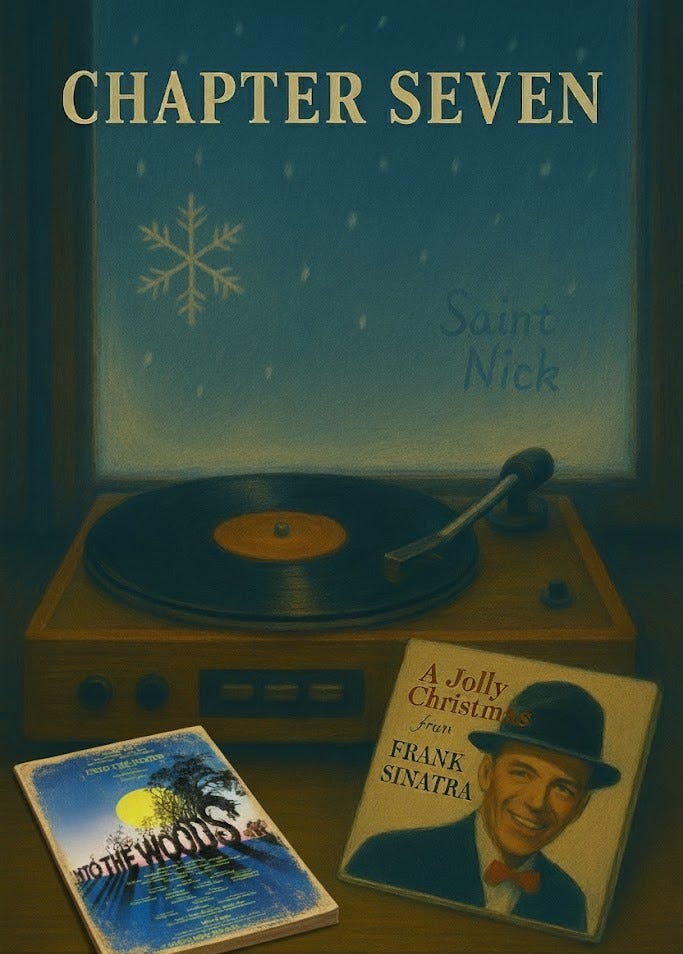
The auditorium doors hush closed behind him, sealing the echo of laughter inside.
Outside, the night feels wider, alive and breathing. Nicolas pauses under the awning, the cold meeting his face like a familiar greeting. He pulls his jacket tight, the script tucked under his arm, still warm from the stage lights.
The air is clear, the kind that hums when you breathe it in too deep. Snow clings to the curbs in pale mounds, glazed from the storm a few days ago. Sidewalks shine where salt and ice have fought to a draw. It’s later than usual. The town runs on its night heartbeat now, fewer cars, longer shadows, that stillness of December after seven o’clock when even the houses seem to settle.
He decides to walk.
It’s only a mile or so, and he likes the time between things, the pause between leaving one world and stepping into another. After rehearsals, imagination always clings to him like static. It hums behind his eyes, replaying the lines, the lights, the way it feels when a scene clicks.
His boots scuff softly on the pavement. A thin crust of snow crackles under each step.
A car glides past, tires whispering, headlights sweeping across him before fading away.
He looks up. Cloudless. A cold, dark blue glowing faintly above the rooftops. Somewhere, a jet blinks its way across the horizon. The world feels both enormous and completely his.
He exhales, watching his breath twist into the night, a small ghost drifting away. He smiles, not wide, just enough to show he’s listening.
Nights like this always feel like they’re leading somewhere.
At the corner, Nicolas stops and waits for the walk signal to change. The light above him shines red on the wet pavement. He shifts his weight, the script tucked close against his chest. Into the Woods printed across the cover, the corners softened from use. A play about what happens when wonder grows up. Lately, that part feels more real than the fairytale.
He stands beside the bus-stop shelter, leaning against the outside. Inside, a mother and daughter wait on the bench, their breath fogging the glass. The little girl slouches, swinging her legs, mittened hands folded in her lap. Her hat tilts to one side, the pom on top wobbling as if it’s tired too.
Nicolas watches a moment longer. Then, without thinking, he slips off his red mittens, pockets them, and draws a Christmas tree on the fogged glass panel beside him. The lines are uneven, the branches crooked, but under the streetlamp’s yellow glow the tree feels alive.
The girl looks up. Her eyes widen; the weariness disappears. She hops off the bench and steps closer to the opposite side of the glass. Her mitten traces a small box beneath his tree, then another, each wrapped with an invisible ribbon.
Nicolas smiles. He adds one more branch, then lifts his finger to draw a star at the top.
The girl beams, her whole face lighting up. She presses both hands against the glass as if to steady the tree, her breath misting over the star until it glows even brighter.
Her mother checks her phone, unaware. A bus pulls up, headlights sweeping across the sidewalk, brakes sighing as the doors fold open.
The girl hesitates, gives the tree one last look, then follows her mother inside.
The light turns green. Nicolas steps off the curb and crosses the street. His boots click against the pavement, steady and calm.
As he reaches the opposite corner, the bus rolls past. Through the window, he spots the little girl again, smiling wide, her mittened finger tracing tiny snowflakes on the glass beside her seat.
Nicolas watches, a quiet smile finding its way to his face. There’s something beautiful about seeing that kind of joy, about knowing he helped spark it. It feels good to know that wonder is still alive.
He keeps walking, the night clear and calm, his breath rising soft against the cold.
He slows near an open field, the kind of space that feels endless at night. The snow lies mostly untouched, smooth except for a few scattered tracks left earlier in the day. He crouches and scoops a handful of snow, bare-handed. The cold bites instantly, but he keeps shaping it, letting the top layer melt just enough to pack firm.
He looks across the field to a tall tree near the path. A grin spreads across his face.
“Bottom of the ninth,” he whispers. “Two outs. Runner on first.”
He sets his feet, bends low, and pretends to field a groundball. With a flick of his wrist, he fires the snowball across the open field. It sails true, striking the trunk with a sharp thwack.
“Out at first!” he shouts, spinning in triumph.
When he turns, he sees an old man standing on a porch across the street. The man wears a heavy coat and slippers, a steaming mug in one hand. He doesn’t call out, just smiles and raises his free arm, mimicking an umpire’s signal with perfect form.
Nicolas freezes for a beat, then breaks into a laugh. He gives a small salute, half embarrassed, half proud, and starts walking again.
As he glances back, the porch light glows warm across the snow, and the mark on the tree gleams faintly in the dark. He slips his red mittens from his pocket and pulls them on, the warmth blooming through his fingers.
“Great call, Blue,” he mutters through laughter. “Could’ve gone either way.”
Nicolas turns down a smaller street where the houses sit close together, each one trimmed with faint traces of light. Halfway down the block, a small movement catches his eye, a boy, maybe six or seven, kneeling in a yard under a dim porch light. His gloves are caked with snow, his face flushed red from the cold. In front of him lies a half-collapsed snowman, its head split in two, button eyes buried somewhere in the drift.
Nicolas crosses the street without thinking. “He had a rough night, huh?”
The boy’s breath comes out in quick little clouds. He nods, gripping the misshapen head that keeps sliding off the body.
“Okay,” Nicolas says, dropping to a crouch. “Trick is tighter snow and a better base. Watch.”
He breaks the torso back down, packing snow hard with the flats of his palms. Turns it. Packs again. The boy copies him, eyes narrowed with purpose instead of panic. Together they press fresh snow against the base, smoothing the sides until it feels sturdy. The head goes back on, balanced and straight.
Nicolas studies it, then loosens the scarf from around his neck, still warm from his breath, and wraps it gently around the snowman’s shoulders. The red stands out against the white, bright under the porch light. He stays there on one knee beside the boy, brushing snow from his mittens.
“Now he looks like a snowman,” Nicolas says quietly.
The boy stares for a moment, face pink from the cold, and nods with a grin that feels too big for his face. “He really does,” he says softly.
They both stay there a moment longer, just looking at what they made. The street is still, wind whispering through the trees, a porch chime rattling faintly. Then the boy bounces once on his heels, sudden energy returning.
“He needs a name,” the boy says.
Nicolas pauses, still on one knee. His eyes catch the red scarf, the way it flutters faintly in the cold. He turns toward the boy until they’re eye to eye. A small smile forms, quiet and sure.
“How about Merryweather?”
“Merryweather!” the boy shouts, as if calling someone from far away. He bolts for the porch, a trail of boots and joy. “Mom! Dad! Come look at Merryweather!”
Nicolas stands, brushes himself off, and smiles to himself as the voice echoes down the block and turns into laughter behind him.
A few houses down, a man stands halfway up a ladder, a bundle of Christmas lights looped around his arm, muttering to himself as he works.
“Careful, Mr. Russo,” Nicolas calls.
The older man peers down over the rung. His knit cap has a ridiculous pom, and somehow that makes him look more dignified. The strand slips from his glove and tumbles toward the ground. Nicolas catches it before it hits.
“Nice catch, kid,” Russo says, climbing down one step, then another.
“Would’ve been a shame not to see them all lit,” Nicolas says, feeding the strand back up the rungs like a rope in a rescue.
“You ain’t kidding,” Russo replies, clipping the end of the lights to the gutter.
They both step back, looking up at the drooping line of bulbs. Russo plugs them in with a grunt that’s equal parts triumph and arthritis. The bulbs hesitate, blink, then give in all at once. Color washes the snow, red on the walk, warm white on the aluminum mailbox so it looks like a decoration instead of a dent.
“Still got it,” Russo murmurs, proud in a way that has nothing to do with lights.
“Looks great. Night, Mr. Russo,” Nicolas says, stepping back toward the sidewalk.
“Night, kid. Merry Christmas.”
At the next corner, the town opens up again. A small diner sits at the end of the block, its windows glimmering against the cold. The sign above the door buzzes faintly, one letter flickering in and out. Inside, a few late customers linger at the counter while a waitress refills coffee for a man half-asleep over his plate.
Nicolas slows as he passes. Through the glass he spots a girl standing on a stool, painting snowflakes on the window with a small brush. She’s about his age, maybe a year younger. Her hair falls loose over her shoulders, and she wears a gray sweatshirt streaked with white paint.
The lights from inside halo her reflection, layering her image against the night outside. For a moment Nicolas can’t tell which one of her, the real or the reflected, is facing him.
Her brush moves easily, an arc across the glass, then a looping flake. She leans back to check her work, head tilted slightly.
She catches him watching and lifts one eyebrow. Through the glass her voice is muffled but amused. “Something wrong with it?”
“No,” he says, pointing vaguely at the pane. “Just a little off-center.”
She snorts softly. “Bold from a stranger.” But she shifts the next line anyway, right by a fraction only people who care would notice. “Better?”
He squints, and for once the performance lands right. “Eh…”
Her brow lifts higher in mock outrage. He grins, and it’s a peace treaty without a signature. “Yeah,” he says. “Better.”
She laughs, then studies him with curious eyes. “What’s your name?”
“Nick.”
She grins, dips her brush, loads a little white, and in the corner, in small, looping letters, writes Saint Nick.
Nicolas blinks and laughs before he can decide not to. “I’ll try to live up to the name.”
Her eyes find his through paint and glass and light. “Don’t try,” she says, and it isn’t a joke at all. “Do something with it.”
The sentence lands so precisely he actually sways backward. There’s no edge in the words. It isn’t a dare; it’s a challenge.
He opens his mouth to say something - anything, everything - but her brush is moving again, each stroke small and decisive.
“Better get started,” she adds without looking up, and the bell on the diner door rings somewhere behind the counter, as if it had been waiting for that line.
Nicolas stands there for a beat too long, the cold making a better argument by the second. He doesn’t know if he’s been called out or called forward - maybe both.
When he finally starts walking again, the cold feels different, softer somehow. He glances back once more. Inside, her reflection shimmers between the painted flakes and the faint glow of the words Saint Nick.
Nicolas turns onto his street and slows as his house comes into view. The tree in the front window blinks in its steady rhythm, the same one that’s been set since he was a kid. Inside, shadows move faintly across the curtains, a familiar dance of comfort and routine.
He steps onto the porch and eases the door open. Warmth greets him all at once, smelling faintly of pine and fireplace. His dad is already upstairs asleep, the television humming low in the background. His mom stands at the sink, rinsing her mug, already half-turned toward the stairs.
“Hey, you,” she says, not surprised to see him. “How’d rehearsal go?”
“Good,” he says, setting his script on the table. “Lines are finally sticking.”
She smiles, soft and easy. “Can’t wait to see it.” She dries her hands on a towel, then points toward the living room. “Don’t stay up too late,” she says as she starts up the stairs.
“I won’t,” he lies gently, because it’s tradition.
As the house settles, he kneels by the tree, adjusting a strand that’s slipped loose near the bottom. He reaches under the lowest branches, checking the wire where it meets the outlet. The lights blink once, then steady again, their rhythm slow and patient. The faint scent of pine rises as his arm brushes the needles.
When he looks up, he realizes he’s half under the tree, the same way he used to crawl beneath it when he was little, lying there for what felt like hours, just watching the world through the warmth.
For a moment everything else, the snow, the diner, the quiet streets, falls away. He’d spent the night giving out little sparks. Now the house gave one back.
A sound behind him. He turns. His mother stands at the foot of the stairs, one hand on the railing, the other holding her mug. She’s watching him, a small smile finding her face.
Their eyes meet.
In hers, the same quiet understanding that’s always been there.
In his, a sheepish smile that says without words, I know he’s not real.
And in hers again, the warmth that answers, I know. But you are.
She takes a slow breath, the moment hanging gently between them.
“Goodnight, Nic,” she says, her voice soft, almost a whisper.
“Goodnight, Mom.”
She turns toward the stairs. The step that usually creaks doesn’t. It never does on nights like this.
Nicolas stays where he is, lying beneath the tree, surrounded by the quiet pulse of its light. He exhales slowly, the air now warm - and the night exhales with him.
He stays there for a while, listening to the hum of the house. The lights from the tree pulse in slow rhythm, blinking warm against the walls. Somewhere upstairs, a door clicks shut, and the quiet deepens.
After a moment, he rises and walks to the old record player near the window. The wood is worn smooth from years of December hands lifting its lid. He slides out the record without looking, Frank Sinatra: A Jolly Christmas.
The vinyl slips onto the turntable with a soft scrape. He lowers the needle, and for a moment there’s only the faint hiss of dust in the grooves, the whisper before the memory starts to sing.
He drops into the couch, and the warmth of the room folds around him.
“Have yourself a merry little Christmas…”
Sinatra’s voice drifts through the air, low, close, familiar. The tree lights double themselves in the window so it looks like there’s another living room out there, and there probably is.
“Let your heart be light…”
A fogged window. A Christmas tree drawn by one hand, presents by another. The soft gasp of a child’s joy, her mitten pressed to the glass like she’s holding the world in place.
“Here we are as in olden days, happy golden days of yore…”
A snowball flying clean and true. The echo of laughter across the park. An old man on his porch, eyes bright, calling the play with a grin he hasn’t worn in years.
“Faithful friends who are dear to us…”
A boy and his snowman standing taller than before, scarf wrapped tight around his neck. Merryweather, the name called out into the night like an old friend’s return.
“Through the years, we all will be together…”
The girl painting the diner window. How she’d met his teasing with that small, fearless smile, then spoke with a confidence that felt like light breaking through glass. Her eyes held his, calm and certain, steadying the noise inside him until all that was left was her.
“…if the fates allow.”
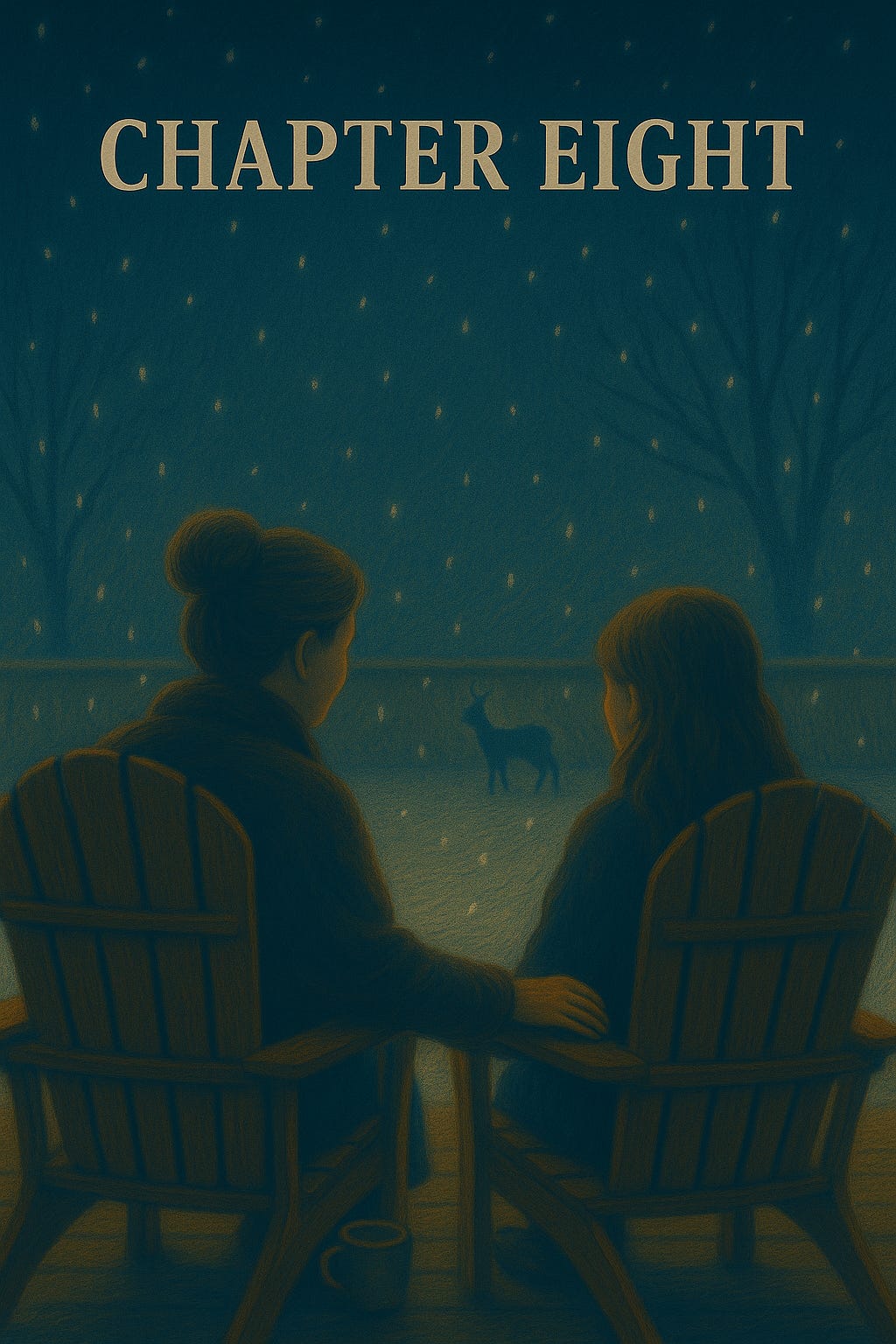
Eve sat by the front door, tying her running shoes. She looped the laces tight, tugging once, then again, the way she always did until they felt secure. Her phone rested on the entryway table beside a folded scarf and a half-finished mug of coffee her dad had left that morning.
From the kitchen came the low murmur of her mom’s voice. She was on the phone with a friend, laughing softly, a sound that had been missing from this house for far too long. The hum of it filled the air like music, something light and ordinary.
Eve swiped her thumb across her phone and opened her playlists. After scrolling past a dozen half-hearted mixes, she settled on one called New Year, New You.
She slipped the phone into her pocket and stood. Her reflection in the small mirror by the door caught a flash of movement as she tied her hair into a ponytail. A single strand escaped near her temple, and she let it fall.
“I’m going for a run,” she called toward the kitchen.
Her mom’s voice floated back, bright and distracted, still half in her conversation. “Be careful. It’s colder than it looks!”
“I will,” Eve said, smiling to herself.
She zipped her jacket and opened the door.
Cold air swept inside, clear and bright, smelling of pine, smoke, and damp pavement. The chill met her face like a soft shock. She paused for a breath, filling her lungs until it almost hurt, then stepped out onto the porch. The door clicked shut behind her, sealing the warmth inside.
Outside, the street was hushed. It was a Sunday afternoon in January, just past three, that hour when daylight begins to thin and the world feels like it is holding still before night. Christmas trees lay at the curb, their needles stiff with frost, a few silver tinsel threads still clinging to the branches. A plastic snowman leaned sideways beside a recycling bin, smiling toward nothing. The season had ended, but its shadow lingered.
Eve adjusted her earbuds and began to run.
The first few steps were awkward, her legs heavy, shoes slapping lightly against the cold ground. The pavement was damp and dark, and the air bit at her throat until she found a rhythm. Her arms swung easily now. The sound of her breath settled into the music pulsing in her ears.
She ran past mailboxes and bare hedges, past windows glowing faintly gold. Her breath came in small clouds that trailed behind her. The chill in her chest softened as her body warmed.
It had been two winters since everything had changed, and one since the house had begun to sound like itself again. Last year had been full of whispers and waiting rooms and nights when the only light in the kitchen came from the microwave clock. Her father had stopped humming while he cooked, as if sound itself had been too fragile to trust.
Now the house had sound again. Her mom’s voice. The creak of the old floorboards. The hiss of the kettle.
The air cut colder as she turned onto the next block. The houses here were older, their driveways still patched with frost. She watched her shoes hit the ground in rhythm, one after another, until the rest of the world faded into blur and motion.
Her mind turned toward what came next.
There would be college applications soon. Her mom already kept a folder on the counter labeled Schools to Consider, the edges marked with colored tabs. Eve pictured walking across a campus in late autumn, brick buildings and turning leaves, her breath visible in the air. She would study something useful. Maybe medicine or business. Something with steps she could follow.
She imagined her life unfolding from there, one clear shape after another. A small apartment with plants on the windowsill and music drifting from the next room. A job that paid well enough to feel secure. Maybe a husband who cooked dinner while they discussed their days. Two children. A house with a porch light that always worked.
None of it felt like a fantasy. It felt orderly, possible, the way the world should be.
Her pace slowed as she turned the corner, lost in thought. Not thoughts of adventure or fame, but the kind of life that stayed still. The kind that didn’t disappear.
The wind shifted and caught her hair, brushing it against her cheek. She glanced up. The sky had softened to a blue-gray, the kind that came before early darkness in January. Streetlights were just beginning to hum to life.
She exhaled, breath clouding the air. Her body felt warm now, her lungs steady, her pulse strong.
Eve smiled to herself and kept running.
The air carried a faint sweetness, the smell of smoke and something almost metallic from a nearby chimney. Her shoes hit the pavement in a steady rhythm. She didn’t think about her pace anymore. Her body knew the rhythm.
Somewhere ahead, a voice rose suddenly through the quiet.
She glanced toward it, half expecting to see someone talking on the phone or calling a dog, but instead she saw a boy in a nearby yard, bundled in a sweatshirt and mittens, holding a football.
He took a few quick steps backward, laughter spilling from him as he called out to no one in particular.
“Drops back. Five seconds on the clock. He throws deep…”
He threw the ball high into the air. It spiraled against the fading light, arcing almost perfectly above him. The boy sprinted forward, eyes locked on it, his voice rising with the momentum of his own story.
“…dives for it… he catches it! Touchdown!”
He stumbled as he rose to his feet, nearly falling, but caught himself and threw both arms up in victory. His breath hung in the cold air, white and bright against the darkening sky.
Eve couldn’t help but smile. It wasn’t just the silliness of it that struck her. It was the fact that he was about her age and still out there playing, talking to himself, caught in his own little world.
She couldn’t remember the last time someone her age looked that free, like they hadn’t noticed the invisible line everyone else had crossed.
Her music played on, but she barely heard it now.
As she passed the yard, she looked ahead again, letting the rhythm of her feet carry her forward. Behind her, his voice echoed one last time, muffled by the wind.
Then it was quiet again. Just the sound of her steps and the low hum of streetlights warming to life.
But something about his laughter stayed with her, faint and shapeless, a reminder that joy could still live out in the open like that.
Eve turned the next corner and kept running.
She slowed to a jog, then to a walk. The cold clung to her as she climbed her porch steps, each one creaking the way it always had. When she opened the door, warmth wrapped around her, the smell of garlic and rosemary, the faint hiss of something simmering on the stove.
Her father stood in the kitchen, stirring a pot. He hummed softly, the tune uneven but cheerful. For a moment, Eve just watched him. That sound, the one that had disappeared during the hardest months, filled the space again like it belonged there.
“Hey, you,” he said when he noticed her. “How was it out there?”
“Cold,” she said, unzipping her jacket. “But good.”
He nodded toward the hallway. “Your mom’s making tea if you want some.”
From the living room came the faint sound of her mom’s laughter again, still on the phone, still light. Eve smiled and slipped off her shoes, toes tingling as the warmth of the floor reached them.
Her father’s humming grew louder as he reached for a wooden spoon and tapped it against the side of the pot like a conductor finding rhythm. Eve leaned against the counter, closing her eyes for a moment.
The warmth in the room, the sound, the smell... it all felt like proof of something holding steady.
When she opened her eyes again, her mom was standing in the doorway, phone pressed to her shoulder, smiling.
“Dinner in ten,” she said.
Eve nodded. “Okay.”
Her mom’s smile lingered a moment longer before she went back to the living room.
Eve stayed where she was for a moment longer, looking out the window by the table at the soft light gathering on the street, the quiet house behind her alive with small sounds.
She took a slow breath and let it fill her completely before stepping away from the window, her father’s humming following her down the hall.
The evening settled into its ordinary rhythm.
Dinner was finished, the dishes cleaned, and the kitchen lights dimmed to a soft amber. The faint roar of the television carried from the living room, her dad watching the playoff game, talking to the screen like it could hear him.
Eve sat curled on the couch, her knees pulled up beneath a blanket, the glow of her phone bright against the dim room. Her thumb moved automatically, scrolling past one thing after another: a video of someone lip-syncing into a hairbrush, an argument in a comment section, an ad for a gadget that folded sandwiches into perfect triangles. None of it mattered. None of it stayed.
She wasn’t even really watching anymore; she was just moving. The sound of the game behind her blended with the noise from her feed, both of them full of voices saying everything and nothing at the same time.
Through the reflection on her screen, she noticed the faint shape of her mom outside.
The sliding door was cracked open, letting in a thin thread of cool air. Her mom sat on the deck with a blanket around her shoulders and a mug in her hands, her face lit gold by the porch light.
Eve scrolled again. Another pointless video. A dance. A dog barking at its own reflection.
Then something flickered at the edge of her vision. She looked up and saw a soft glimmer beyond the porch, a deer standing at the edge of the yard. Its breath rose in small, visible clouds. For a moment, it just stood there, watching the light. Then it turned and stepped quietly into the trees.
Her mom didn’t stir, only lifted her mug slightly, as if acknowledging it.
Eve looked down at her phone again, but the screen felt different, smaller, louder, hollow. Someone was filming themselves eating a spoonful of cinnamon and coughing for likes. A man with too-white teeth was trying to sell her a miracle vitamin.
She blinked, huffed, and locked the screen.
For a second, she just sat there, staring at the dark glass that reflected her mom’s silhouette outside. Then she set the phone on the coffee table, pushed back the blanket, and stood.
When she slid the door open, the air met her like a cool hand against her face, quiet, real, alive.
Her mom looked over, smiling. “Did you see the deer?”
“Yeah,” Eve said, stepping outside. “It was right at the fence.”
“I know,” her mom said. “I think it’s been coming by every few nights.” She lifted her mug slightly. “I was hoping it would stop long enough for me to thank it for visiting.”
Eve smiled and sat beside her, pulling her sleeves down over her hands. “What are you drinking?”
“Chamomile,” her mom said. Then, glancing toward the living room, “Who’s winning the game?”
Eve smirked. “Apparently not the team Dad wants.”
Her mom laughed softly. “I could tell by the groaning.”
They both looked out into the yard, quiet settling between them. The world beyond the porch was still and dark, the neighbor’s windows glowing faintly through the trees.
Her mom took another sip of tea. “It’s nice out here. Feels calm.”
“Yeah,” Eve said. “It does.”
Neither of them spoke again. The wind moved through the branches, light and cold, and for a moment the night felt perfectly balanced, sound inside, silence outside, everything in its place.
Then Eve noticed it, the first few flakes drifting through the porch light. Not heavy or sudden, just quiet, steady, unhurried.
Her mom tilted her head back to watch. “Would you look at that?”
Eve held out her hand. “I didn’t think it was supposed to snow tonight.”
“It wasn’t,” her mom said softly. “Guess it decided to surprise us.”
They watched as the snow gathered in the light, small flakes catching on the railing and melting into the wood. The air smelled faintly of cold and something clean.
Eve leaned back in her chair, the cold brushing her face, and exhaled. Her mom set her mug down and reached over, resting a hand on Eve’s arm.
They sat together in silence, the soft sound of snow filling the space between them.
The house had gone quiet.
The television was off, the lights low, the air warm and still.
Eve walked down the hall to her room, the floor cool beneath her feet. She left the door open, letting the faint sound of her parents’ laughter drift through from the living room. It rose and fell like music, easy, ordinary, alive.
She crossed to the window and looked outside. Snow drifted through the streetlight, soft and slow, catching the glow before disappearing into the dark.
For a long moment, she just stood there, her breath fogging the glass. Then she leaned forward and pressed her forehead against the window. The chill met her skin, clear and grounding.
Behind her, the laughter carried through again, her father saying something, her mom’s voice following with a soft burst of laughter.
Eve smiled, eyes closed. For the first time in a long time, she let herself feel everything exactly as it was, the warmth, the quiet, the safety of this small, fragile world.
In the next town over, Nicolas sat on the edge of his bed, the light from his desk lamp spilling across a mess of notes and a half-open textbook. The lines blurred together in the yellow glow, sentences he’d read and reread until they stopped meaning anything.
He sighed, rubbed his eyes, and looked toward the window. The snow was falling again, slow and unhurried, turning the street below into a quiet watercolor.
He stood and crossed the room, shoulders heavy, staring out at the falling snow. His eyes were tired from trying to focus on words that refused to stay still. The pages might as well have been blank for how little they meant anymore.
He dragged a hand through his hair, exhaling hard, then stepped closer to the window. For a few seconds he just watched, following the flakes as they passed through the streetlight. Then he leaned forward until his forehead touched the glass.
The chill bit gently at his skin, and for a moment, everything inside him went still. The words, the pressure, the noise, all of it faded until there was only this.
The cold pressing against his skin, the steady fall of snow, the sound of his breath.
A quiet that didn’t feel empty, but full.
He closed his eyes and stayed there, forehead against the glass, as if the world outside might slow down long enough for him to catch it.
The snow fell through both towns long after they’d gone to sleep, softening everything it touched. By morning, the roads would be different, the world covered in a thin new layer. Quiet proof that even when nothing seems to move, everything is still changing.
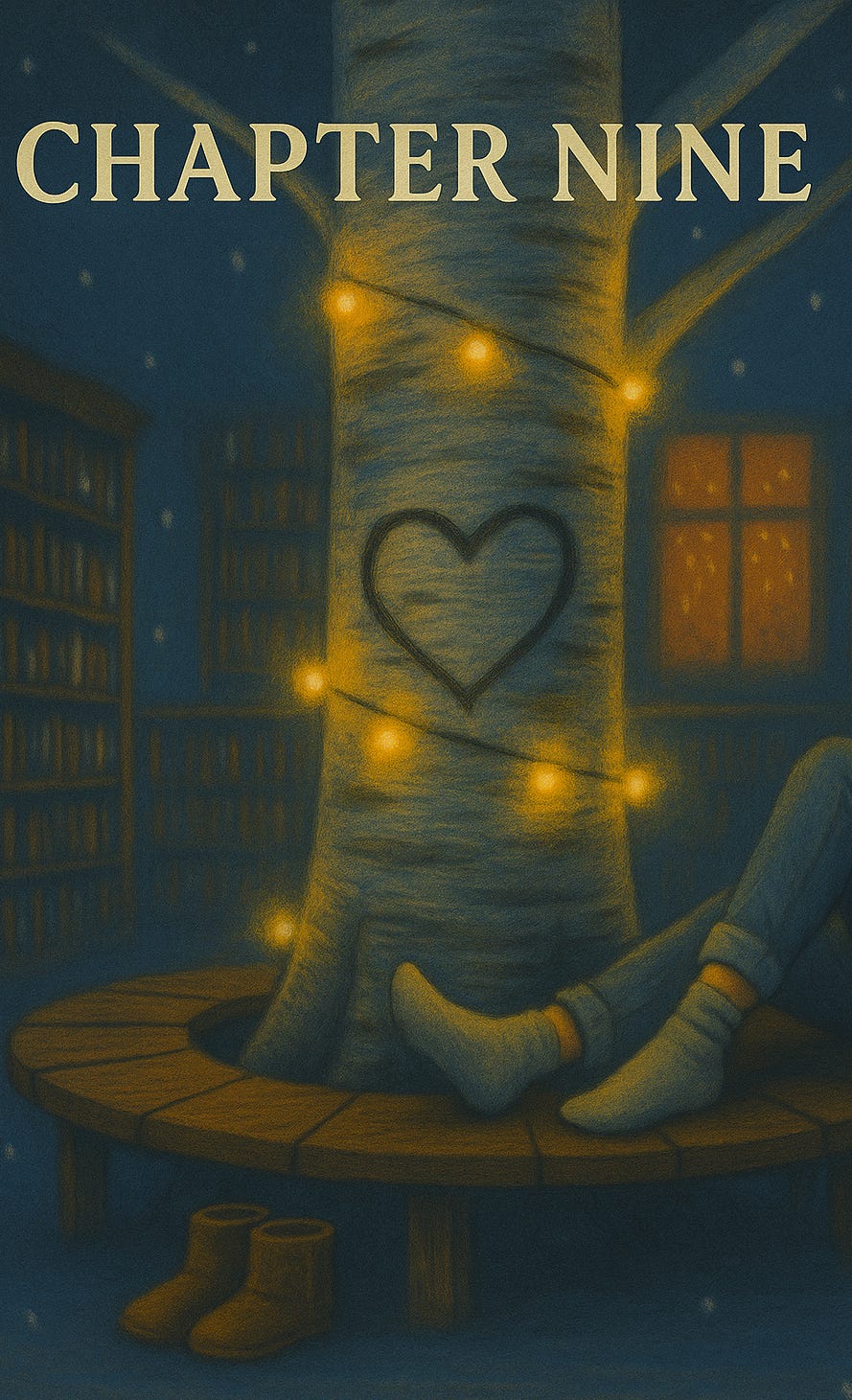
The bookstore didn’t look like much from the outside.
The sign hung crooked under a single dim bulb. It was the kind of place people passed without realizing it was still open.
Nicolas pushed in with the heel of his red mitten and let the doorbell’s small jingle roll through him. The sound felt like a stage cue. He wasn’t looking for a book. He just liked the quiet and the smell, the way time seemed to move politely in here.
The warmth took its time finding him. The air smelled of coffee and pages softened by age. A space heater hummed near the counter, warming a small basket of scarves set out for sale. A cardboard box marked DONATIONS sat by the door, overflowing with old paperbacks and a pair of wool gloves that didn’t match. He smiled at that; imbalance, somehow, always felt right to him.
He told himself he liked places like this because they were quiet. But really it was because no one here asked what came next. He could stand still without explaining it. The rest of his life lately felt like a hallway full of doors that didn’t quite open.
A white birch tree rose through the floor near the center of the shop, not a column carved to look like one, but a real, living birch. Its bark caught the light like frost, the thin curls peeling at the edges, each strip the color of old paper. A ring of benches circled the trunk. Someone had wound white string lights up through the branches, and the glow bounced off the bark until the whole tree looked like it was keeping its own secret.
He wandered toward the shelves marked DRAMA. Titles lined up like old friends: Prisoner of Second Avenue, The Glass Menagerie, Death of a Salesman. He ran his finger along the spines until one stopped him.
Into the Woods.
He hadn’t thought about that play in months. Maybe years. He pulled it from the shelf and thumbed through, pages soft from other hands. He’d loved it since high school, the way it tricked you into thinking it was a fairy-tale and then told you the truth instead.
He could still remember the first time he saw it, sitting in a squeaky auditorium chair while his drama teacher whispered lyrics under her breath. It was the first time he’d understood that stories could tell the truth by lying beautifully.
He was about to slide it back when the bell over the door chimed again, a small sound that drew his eyes toward the bench beneath the tree.
A girl sat beneath the birch, caught in the kind of light that makes you think you’re seeing something meant only for you.
She sat with her legs tucked beneath her, thick wool socks bunched at the ankles, her toes wiggling as if getting comfortable. Her boots sat beside the bench, soles dusted with snow. A notebook rested against her knee. A strand of hair fell forward as she wrote, and every so often she twirled it absently around her finger while reading back over whatever she’d just scribbled.
He stood there with the play half-shelved. Instead of putting it back, he opened it and stared at the page, pretending to read. His eyes stayed a few inches above the words, fixed on the girl under the tree.
She looked up.
Her gaze met his, sharp enough to make him blink, but not unkind. She noticed the book, tilted her head slightly, and lifted her hand. With two fingers she made a small turning motion.
He glanced down. The book was upside down.
Of course it was.
Heat crawled up his neck. He turned it right-side up, slow and deliberate, and when he looked back she was smiling. He gave a tiny two-finger salute in surrender.
She shook her head, amused.
Without letting himself think too long, he walked over.
Not to her directly. That felt too forward. He went to the bench. The other side. A respectful distance.
He sat down and opened Into the Woods in his lap. Didn’t read a word.
She didn’t look up.
The corner of her mouth tipped, just slightly, as she scribbled something in the notebook.
He glanced sideways. Not directly at her. Just enough to catch the way her brow furrowed when she focused, how her mouth moved as she silently reread her own words.
“It’s upside down again,” she said, eyes on her notebook.
He checked. “Not this time,” he said, grinning. “But earlier? Extremely.”
That got a laugh.
A small one, but real.
“So what’s that one?” she asked, nodding toward the play.
“Into the Woods,” he said. “Favorite of all time. Not just because of the music. Because it gets honest at the exact moment you expect it to lie.”
She raised an eyebrow. “You quote that often?”
“I keep it in my back pocket in case I stumble upon attractive women under fictional trees.”
She tried to keep a straight face.
“You’re lucky I like fictional trees,” she said.
“Lucky is a strong word,” he replied. “I’ve been rehearsing this conversation for years.”
The laugh came easy now.
She stood and crossed to the other side of the bench and sat, close enough that he could feel the difference.
He froze. Relief bloomed through him.
She didn’t say anything.
Just let the moment settle between them.
Nicolas looked down at the play in his lap.
Then at her.
She said, gently, “I’m Eve.”
He blinked once, like she’d said something more important than a name. “Nicolas.” A soft nod. “Nice to meet you in the fairy-tale section.”
Their eyes held for half a second longer than necessary.
They both looked away, at their books, at the floor, anywhere else.
“You know,” he said, gesturing to the play, “there’s this moment where the Baker’s Wife sings ‘Moments in the Woods’. It wrecks me every single time.”
She studied him curiously.
“Because it’s about choosing real life over fantasy, but also wondering—why we’re asked to choose.”
She grinned.
“And you relate to that?” she asked.
“I think,” he said slowly. “I’m still stuck between the trees.”
Eve’s mouth curved, her eyes warm.
Silence settled in for a beat, but it wasn’t awkward. The birch lights hummed faintly overhead, white against white, like distant snow.
He took in the small details because that’s what his attention did when it was happy: the wet crescent darkening the toes of her boots on the floor, the faint smudge of ink on her thumb, the loose thread hanging from the cuff of her green sweater. Everything ordinary looked alive.
“So,” she said, “what do you do when you’re not pretending to read upside-down plays?”
He smiled. “I work with my dad at an office near the edge of town. Sorting mail, answering phones, whatever needs doing. But on the other days, I drive into the city for auditions.”
Her eyebrows lifted a little. “Auditions?”
“Yeah—I’m trying to be an actor.”
“Trying?” she repeated, curious more than skeptical.
He hesitated. “I mean, it’s not exactly the easiest thing to become. I drive in, wait in lines, say the same few lines to different people, hope someone says yes. So, yeah. Trying.”
She studied him, expression unreadable. “Doesn’t sound like you’re trying.”
His stomach dipped. “No?”
She shook her head, smile creeping back. “Sounds like you are an actor.”
Something in his chest unfolded. “That’s… probably the nicest thing anyone’s ever said to me.”
“It’s true,” she said. “You talk like someone who sees more than one version of a thing.”
For a second, everything inside him went warm, then too full. Too big, too sudden, too much at once. He wanted to cry or speak or maybe just blurt out I love you and get it over with, but his throat locked up.
He settled for a breath that almost sounded like a sigh. “Wow,” he said softly. “You can’t just… uhm… you have a way of reading people, huh?”
She gave a small shrug, the kind that said she wasn’t trying to.
He exhaled, still a little dazed, and tried to recover, nodding toward her notebook. “What about you?” he asked. “What are you working on?”
“It’s a letter, well it’s supposed to be, but I don’t know how to write it,” she said, tucking a loose piece of hair behind her ear. “Which is inconvenient for a letter.”
“Well, what’s the first line?” he asked.
She huffed softly at the question, letting her smile fade. “The first line is the problem!”
He laughed and nodded toward the page. “Okay, what do you have?”
She hesitated, then read, “I wanted to wait until I knew what I was trying to say, but I think I’ll be old by then.”
He thought for a moment. “That’s great.”
“It is,” she said, and winced. “But it’s the second line. I wrote it second. I keep pretending it’s the first.”
She twirled her hair without thinking, the strand looping around her finger, slipping free, looping again. He found himself timing his breathing to it before he realized he was.
“What’s your first line, then?” he asked.
“For what?”
“For your letter. The real first line.”
She stared at the birch bark for a long second, eyes tracing the paper-white curls, the gray seams. When she looked back at him, she looked almost amused, like she’d caught herself overcomplicating a knot in a shoelace.
“Hi Mom. I’m okay.”
His eyes lit up. “That’s the one.”
“It’s not clever.”
“It doesn’t need to be.”
She let that sit. “Maybe I needed a stranger to say that.”
“Technically,” he said, “we’re past strangers. I think we’ve entered the magical storybook tree acquaintances phase.”
“Right,” she said, fighting a smile. “Huge promotion.”
They went quiet the comfortable way again. The birch lights hummed softly, the little white bulbs reflecting off the bark so the whole trunk looked like winter learning how to glow.
“I think I like this place,” he said.
“The tree helps.”
“It does,” he said, looking up. “Do you think the lights get tired?”
“You mean do the lights get sick of people coming in here to have quiet epiphanies under them?”
He blinked. “Is that what we’re doing?”
She gave him a look. “Little bit.”
“Okay.” He blinked. “That’s fair.”
He kept watching the way the light slid over the birch bark. It came down the trunk in slow ribbons, catching on the curls of peeling bark until it looked like the tree was quietly breathing. For a second, he had the strange, certain feeling that the world had paused just long enough for him to notice it.
Eve tapped her notebook lightly against her knee. “You ever notice how the quiet makes people honest?”
He looked over, a half-smile forming. “What do you mean?”
She shrugged, still tracing the grain of the page with her thumb. “I don’t know. It’s like when everything else shuts up, you finally hear what you actually think.”
He nodded slowly, but something in the thought made him uneasy. Quiet didn’t make things clearer for him; it usually made them louder. When the world went still, his head just filled in the space with every noise it could find.
“I think I’d need the quiet to stay quiet first,” he said, smiling faintly.
She looked up, curious. “You don’t like silence?”
“I don’t mind it,” he said. “It just… doesn’t always return the favor.”
That earned a small, understanding laugh.
“Well,” she said, closing her notebook, “then maybe that’s why you talk like someone who sees in layers. Most of us stop at the surface.”
He didn’t know what to do with that, except to look back at the birch, the lights sliding across its bark, and feel, for just a second, completely seen.
Her fingers fiddled with the corner of the page. “Okay,” she said. “I’m going to write the boring real first line and then go home and not touch the rest of it until tomorrow.”
“Strong plan.”
He watched her write it, just three words, small and steady, and felt a strange pride in watching her decide to begin. It was like seeing someone light a match in the dark and realize it could stay lit.
She slid her feet back into her boots, slipped her notebook into her bag, zipping it shut firmly. Something about how efficient she was with everything made him want to be better at being himself.
“I should go,” she said, and it wasn’t an apology. Just a fact she sounded a little reluctant to admit.
“Right,” he said quickly, standing so fast he nearly dropped the play. “Yeah, of course. Go. Leave. I mean...” He stopped himself, cheeks warm. “Thanks for… talking.”
Her smile lingered, soft and amused. “You sure you’re done talking?”
He blinked, then grinned. “I am… unless you’ve got more topics.”
He half-sat again, one arm draped across the back of the bench like he did this sort of thing all the time. It wasn’t smooth, nowhere near, but it earned him the sound he’d been chasing since he first heard it: her laugh.
She shook her head, still smiling, and said, “I’ll see you around, Nick.”
The sound of it—Nick—nearly undid him.
He nodded, but it came out more like a breath. “Yeah. You will.”
She turned toward the door, and he stayed exactly where he was, hands useless at his sides, trying to look like someone who hadn’t just fallen completely in love with a stranger under a tree made of light.
The bell above the door chimed when she stepped into the winter air, a small, perfect sound that felt too delicate for the room it left behind. He thought of the line from It’s a Wonderful Life—“Every time a bell rings, an angel gets its wings.” He smiled, dazed, because there was something about her that made the idea of angels make sense.
Eve had walked this stretch of town a hundred times. It was the kind of route she took without thinking, the kind where her feet seemed to remember each crack in the sidewalk before her eyes did. The air had that in-between quality again; not winter anymore, but not quite anything else. Trees were bare, but the light was softer than it had been a week earlier.
She wasn’t planning to stop anywhere. She was just walking. That was what she told herself. She needed the break from school and college prep and constantly thinking about what’s next. She needed the air. She needed a route that wasn’t a straight line from one responsibility to the next. That was the explanation she stuck to as she passed the florist and the bakery and the small café that always put out too many chairs even when the weather didn’t deserve it. She didn’t question why she chose this street over any other. It felt easy, and she let it be easy.
She was only a few steps from the bookstore before she realized she had slowed down. The window displayed a crooked stack of used hardcovers. Her hand was halfway to the door, as if her body had decided before her mind had caught up.
The bell chimed when she walked in. It wasn’t a cheerful sound. It was small and a little tired, but gentle in a way that fit the room. The air smelled a bit stale. Coffee someone had left too long on a burner. Dust that had settled into the cracks of old wood.
The owner sat behind the desk with a book open across their lap. They lifted their eyes in greeting and then went back to reading. Eve nodded back, just as quietly. That was part of what she liked about this place. It didn’t insist on anything.
She wandered without much direction, letting her fingers trail lightly over spines the way a person might let their hand skim along a railing without looking at it. She wasn’t hunting for anything. She wasn’t even pretending to. Each row had its own smell. The poetry section smelled a little sweeter. The science shelves always had the faintest trace of metal in the air, like cold coins. The children’s section felt warmer, though she could never tell if that was her imagination or the way the carpet absorbed light.
She passed under the soft glow of the birch without stopping. The tree rose from the floor like it had grown there long before any walls existed. Its bark peeled in pale curls, delicate as the edges of old book pages. A strand of lights was still wound through the branches. The bulbs had a slight hum. They cast a glow that wasn’t bright enough to warm anything, but bright enough to feel like the memory of warmth. She didn’t pause, though her eyes flicked toward it in passing. Her body noted it the way you note a familiar landmark on a route you’ve taken for years.
Her feet took her to the back of the store. To the shelves marked DRAMA. She didn’t think about the path. She just found herself standing there, facing the rows of titles with a stillness she didn’t question for a moment. She moved her gaze slowly across the spines until it landed.
Into the Woods.
Something in her expression changed before she had the chance to stop it. It wasn’t a smile at first. More like a softening, a small recognition she hadn’t expected. Then the corners of her mouth lifted in a way she felt rather than saw.
She reached for the play and pulled it free. It felt light. Worn. The kind of book that had been through many hands. She let it fall open naturally. The spine bent to a page that clearly had been visited often. A line near the bottom had a faint pencil underline.
She let her eyes take in the line. She didn’t laugh out loud, but something in her chest loosened the way it does when a song you forgot you loved finds you again, uninvited. It wasn’t about the meaning. It was about the familiarity. The odd comfort of repetition.
She closed the play and slid it back into place, aligning it neatly with the books beside it. Her fingers lingered a moment longer than they needed to. Then she turned toward the exit. One step. A second. She reached the edge of the aisle.
She stopped.
It wasn’t dramatic. Just a quiet halt. A moment where something inside her caught up with something her body had known for days. She breathed in, breathed out, and a small smirk began to pull at the corner of her mouth. It was subtle, but unmistakable. It felt like admitting something to herself without having to say it.
She turned around.
Her steps were sure as she walked back to the shelf. She reached out, took hold of the top of the book, and gently flipped it upside down. The title shifted, now leaning at an angle that made no sense, except that it did. She stepped back and looked at it, her smirk deepening into something warmer.
She walked out of the store without another pause as the bell chimed behind her.
Days later, Nicolas returned. He told himself he hadn’t meant to go back to the bookstore. He told himself that as he walked the same street he always walked, hands in his jacket pockets, shoulders hunched a little against the early spring chill. Sunlight skimmed the tops of cars, glinted off puddles, and threw small reflections up onto brick walls in flashes that almost felt like movement.
He’d slept poorly the last few nights. Not because anything was wrong. If anything, nothing was wrong at all, and that felt strange. His mind had been sifting through that feeling the way you sift sand through your fingers, trying to understand its weight. He’d drifted between restlessness and something close to anticipation.
He reached the corner where the café sat, the one with tables always waiting for warmer weather. He paused without planning to, watching the steam from a customer’s cup curl into the air and vanish. He realized he’d stopped in a place he usually walked past. His feet pulled him forward again, but slower.
His mind drifted the way it did on long walks, slipping past thoughts he hadn’t fully looked at. There was something there, just out of focus.
He turned onto the block where the bookstore sat tucked between two taller buildings. The crooked sign was visible half a block away. The dim bulb above it wasn’t lit at this time of day, but he imagined it would be later. The thought made him smile for no reason he could justify.
He reached for the door before he’d decided to go in. The bell chimed when he stepped inside. The sound brushed against him with the same soft familiarity as last time. The warmth in the air gathered around him slowly, not quite enough to chase the chill from his coat but enough to settle into the edges of him.
Nicolas let his eyes move through the room. Dust danced quietly in the beams of light coming through the front window. Somewhere in the back, a floorboard creaked as if the building itself shifted in its sleep. The birch tree rose in the center of the store, white and solid and strangely grounding. The lights wrapped through its branches were steady, holding a quiet warmth. He found himself breathing a little deeper as he looked at it.
He wandered through the aisles without choosing a direction, letting his attention pull him where it wanted. It guided him to DRAMA, same as always. He reached the section and brushed his hand along the spines, taking in the textures before the titles. Starting here had become its own kind of comfort.
Suddenly his hand froze for a moment, just a breath.
Into the Woods.
Upside down.
It shouldn’t have meant anything. It was a book in a used shop. Books got nudged. People pulled them out and shoved them back in crooked. Gravity did strange things with time.
Still, the sight pulled a laugh from him before he could stop it. Soft. More breath than sound. Not disbelief or even amusement. It was in between, like being caught mid-step in a thought you didn’t know you were having.
He stepped closer, eyes tracing the spine, the reversed title. He shook his head. “Not this time,” he said under his breath. Not loud enough for anyone else to hear, but loud enough for the moment to hear itself.
He reached out and turned the book right-side up. It sat neatly in the row, innocent and perfectly ordinary now. He lifted it from the shelf, letting the pages fall open the way they liked to. He skimmed a page without taking in a single word.
He wasn’t thinking about the girl from the other day. He told himself that. He told himself he just liked this book. That this place had a good feel to it. That he needed a few quiet minutes in a world that seemed to move too fast everywhere else.
He slipped the play back into place. Aligned it carefully. More carefully than necessary.
As he stepped back, the birch caught the corner of his eye again. Light slid across its bark in a slow ribbon, catching on the curls of peeling wood. For a second, it looked almost like the tree was breathing. He blinked, and the moment passed.
He turned toward the door, the bell chimed again, and he stepped into the cool air outside. The brightness of the afternoon met him all at once. He felt quieter than when he’d come in, the way he did on rare days when his mind decided to give him a little space.
Eve had picked the seat under the birch because it was always the best place to work. The light there never felt harsh, and the branches overhead created a kind of ceiling that helped her focus. At least it usually did.
This afternoon, her homework sat open across her lap, pages covered in notes she’d written earlier in the week. She read the same paragraph twice without absorbing a single word. Her pen tapped absently against the margin. Her focus kept slipping, the words blurring into each other. She blamed the weather at first, the low gray light that drifted through the store like a thin veil. Then she blamed the assignment itself. Then her lack of sleep.
The bell above the door chimed.
She looked up. Fast.
A delivery guy stepped in holding two cardboard boxes. She blinked at her own reaction, then dipped her head again, trying to force her focus back to the page.
A moment later, someone walked past the DRAMA aisle, and Eve glanced over automatically.
The bell chimed a second time.
She looked over even quicker this time. A woman walked in with an umbrella dripping rainwater onto the floor. Eve exhaled slowly and pressed her lips together, then let out a small laugh beneath her breath. She didn’t understand why she kept looking. She told herself it was just a habit, a natural response to noise.
But each time the bell chimed, her heart paused, just for a beat, before she could reason with it.
She tried again. She bent over her assignment, wrote a sentence, crossed it out. Wrote another. Nothing stuck. Her eyes drifted back toward the DRAMA shelves again without permission.
She smiled at herself this time, a soft, slightly embarrassed curve of her lips.
Of course.
She wasn’t distracted because the work was difficult. She wasn’t restless because of the weather. She was waiting. For someone she barely knew. For someone she had met only once. For someone she hadn’t admitted she hoped to see again.
Her cheeks warmed. The feeling startled her, but in a gentle way, like catching herself humming a song without remembering when she started.
She closed her notebook. There was no point in pretending she would finish anything now.
She stood and walked toward the DRAMA section, not bothering to disguise the impulse anymore. Her steps were steady but quiet, as if she didn’t want to interrupt the shelves themselves.
When she reached the shelf, she saw it immediately.
Into the Woods.
Right-side up.
A warmth rose in her chest, one she didn’t try to hide. She reached for the play and slid it from the shelf, holding it in both hands.
She eased it open and let the pages fall naturally. Her eyes landed on a line near the middle:
Anything can happen in the woods.
She read it once.
She read it again.
The words stirred something she couldn’t quite describe. A recognition, the kind that rises from somewhere soft and unguarded.
She closed the book and, without hesitation, set it back upside down.
The small crooked tilt of it felt right, like a signature she hadn’t meant to practice but somehow already knew. Her lips curled into a faint smile she didn’t try to hide.
She walked back to the bench beneath the birch to gather her things. Her backpack waited where she’d left it, but before she reached for it, she stopped.
She looked up.
For the first time, she really saw the tree.
The pale curls of bark catching the soft light. The thin branches stretching upward, holding bulbs that glowed like small frozen stars. The way the trunk rose through the floor as if the shop had been built around it, not the other way around.
It was beautiful.
She let the moment wash over her, quiet and full. Something in her eased, settled, clicked into place in a way she didn’t understand yet. She reached out and touched the bark lightly, her fingertips brushing the paper-thin curl of it. She closed her eyes and sat in the moment.
When she opened her eyes, the air felt fresh somehow. She steadied herself with one last breath, picked up her backpack, and slung it over her shoulder.
The bell chimed as she pushed open the door to step outside.
It didn’t sound tired this time.
It sounded hopeful.
She didn’t look back.
The upside-down book waited on the shelf behind her, ready for whoever might notice next.
Nicolas left work and walked home, hands shoved deep in his jacket pockets. The early spring air felt crisp, caught in that seasonal pause, not cold enough to bite, not warm enough to commit to anything.
A few blocks from work, he missed his usual turn because of a voice he only half-heard. Two teenagers stood outside a deli, one holding up a slice of pie like it was a miracle.
“Is this heaven?” the kid asked through a mouthful.
Nicolas snorted before he could stop himself.
No… it’s Iowa.
The reply surfaced automatically, warm and immediate, the way it always had since he first saw Field of Dreams as a kid. Just hearing those words tugged something in him awake. That movie lived in the same part of him where wonder lived, the part that insisted magic could hide in ordinary places without asking permission.
He loved that idea:
that meaning could settle into the world quietly,
even if no one else noticed.
Once the thought opened that door, the other lines rushed in:
If you build it, they will come.
Go the distance.
And then one more hovered, right at the edge of memory, close, familiar, refusing to land.
This field, this game...
He knew it. He could hear the cadence. But the exact ending phrase stayed just out of focus. Annoyingly close. Close enough to tug at him.
He tried to remember it, slowing down without noticing he’d slowed. By the time he looked up, he had wandered half a block past his usual turn home.
He stopped.
The crooked sign of the bookstore tilted in the distance.
He blinked once, twice, then let out a soft, self-amused breath.
Fine.
If his brain wanted the line so badly, maybe the screenplay was sitting inside. Or a script anthology. Or a movie companion book. Something with the answer printed clearly on a page where he could finally pin it down.
The bell gave its usual quiet jingle when he pushed the door open. Inside, the air held a warmth that never quite reached the corners of the room. A floorboard near the front window let out a creak as the owner shifted in their chair, but they didn’t look up.
Nicolas didn’t linger at the entrance. He walked in like someone checking the fridge even though he knew what was inside. His steps carried him past the poetry shelf, then the biographies. Nothing about the place had changed, but something about his mood made it feel slightly unfamiliar.
When he reached the DRAMA section he ran his fingertips along the spines of the books. The Sound of Music, Newsies, Annie.. and then his hand stopped cold.
Into the Woods.
Upside down.
For a moment he felt completely full, as if the sight lined up perfectly with the way he’s always believed the world could be. His hope rose so fast it held him still, not out of fear but because it felt like the world was finally meeting him at the level of the wonder he’s carried since he was a boy.
He exhaled through his nose, the hint of a laugh caught inside the sound, and reached for the spine. He turned the play upright with an almost too gentle motion. The book clicked softly into place. Perfectly ordinary. Perfectly aligned. Nothing to see here.
But something in him was already humming, and he didn’t know how to quiet it.
He forced himself to walk away from the shelf. He wandered between aisles without really seeing anything, paused by the front counter, then drifted back toward the center of the store. The birch tree stood there, steady as ever, giving off its soft glow. He stared at it as his mind flicked through moments and fragments like someone shuffling through old photographs, each one sharp for a second before blurring into the next.
He wasn’t going to check again.
He wasn’t.
He checked again.
He stepped back to DRAMA and let his gaze slide across the spines, pretending to look for something else. But his attention knew exactly where to land.
Into the Woods.
Still upright.
Still where he’d left it.
For some reason, that steadiness, the complete lack of movement, struck him harder than the flip itself had. It made the whole moment feel suspended, waiting for something.
He backed away from the aisle and headed for the door. Outside, a car splashed through a shallow puddle, and the sound startled him more than it should have. He rubbed the back of his neck as he stepped into the dull light, trying to shake off the feeling that had followed him out.
He’d turned the book.
It hadn’t moved again.
And somehow, that felt less like an ending and more like a beginning.
Halfway down the block, the missing line finally surfaced.
“This field, this game… it’s part of our past.”
Nicolas tried to fall asleep.
He lay on his back first, staring at the faint glow of the streetlamp on his ceiling. Then on his side. Then his stomach. Nothing settled. His mind kept replaying the same quiet moment at the bookstore, not the birch tree, not the aisles, not even the play itself.
Just the book flipped upside down.
He kept telling himself it didn’t matter. That he was reading into something simple. That he was romanticizing the whole thing.
He rolled onto his back again and let out a long, quiet breath.
This was ridiculous.
He pushed off the blankets and swung his legs over the side of the bed. The room was dim and cluttered in the soft streetlight, everything half-shadowed. His desk was a scatter of loose papers and receipts, he nudged aside a stack of monologue printouts, then a folder, then an empty granola bar wrapper.
Nothing he touched felt like what he was looking for.
He pulled open his desk drawer. A tangle of pens and notebooks shifted, and beneath them, pressed against the bottom like it had been flattened by time, was a battered pad of yellow Post-its.
Only three remained.
He raised the pad gently, as if the small number mattered, and for reasons he couldn’t quite explain, it did. He sat on the edge of the bed, turning the tiny stack over in his hand, the corners frayed from being stuffed between things for too long.
He lay back again, the pad resting on his chest, and let his thoughts drift the way they sometimes did when the world went still, slow and circling, touching on moments without fully landing. Eventually sleep found him, light and unsteady, but enough.
He woke before the sun.
The sky outside his window was blue-gray, the kind of morning that felt like it hadn’t quite started yet. He got dressed quickly, grabbing the Post-its and shoving them into his jacket pocket before he could talk himself out of it.
He walked faster than usual.
When he reached the block with the bookstore, the lights were still off. The CLOSED sign hung in the window, quiet and certain. Nicolas stopped across the street, pretending he wasn’t waiting. He looked at his phone. Then at the clouds. Then at the door. Then away again.
A couple of minutes later, the owner appeared with a ring of keys, unlocked the door, and snapped on the lights. The yellow glow spilled across the front of the shop like the day had finally made up its mind.
Nicolas told himself he wouldn’t walk in the second it opened. That it would be weird. That it would look like he’d been standing there waiting for this one specific moment. He’d wait at least five minutes.
He lasted three.
Then he crossed the street, pushed open the door, and stepped inside with his heart beating far too fast for someone who was allegedly here to look for a movie screenplay.
The Post-its felt heavy in his pocket.
He knew exactly where he was going.
He didn’t bother pretending to browse this time. He walked straight for the back of the shop, the Post-its shifting against the inside of his jacket like a small, deliberate weight.
The DRAMA aisle was empty.
He slowed, just a little, as if the moment needed space to reveal itself. His fingers brushed lightly along the familiar spines until he reached the one he had been thinking about since last night.
Into the Woods.
Upside down.
His breath caught. Not sharply, more like the quiet hitch that happens when something impossible becomes undeniable, like gravity changing by an inch.
There it was.
Not coincidence.
Not an accident.
Not some random customer with a habit of shelving things wrong.
It had been flipped again.
Something low in him tightened, warm in a way he didn’t trust yet. The kind that didn’t feel imagined, or exaggerated, or borrowed from a movie he loved.
His hand lifted before he’d told it to. He slipped the play from the shelf, holding it as if the weight might shift and reveal more answers. For a moment he just stood there with it in both hands, leaned back against the bookcase and let the truth of it settle.
Someone had been here.
Someone had done this again.
And the possibility of who flickered through him with an embarrassing amount of force.
He pulled the Post-its from his pocket.
He peeled one off, clicked a pen with the name of the company he worked for on it and started writing.
The first line came out whole, too whole, too much:
“If you flip this again, then some part of you returns to that moment too… and knowing that would undo me.”
He froze.
Absolutely not.
He tore the Post-it off, crumpled it fast, shoved it into his jacket pocket.
He paused, glanced toward the glowing birch, a smile rose to his face before he could stop it. But it curled inward almost immediately, tightening into something that ached low in his chest.
Second attempt:
“I know it’s ridiculous, but the truth is… I think I love you.”
Oh God.
Nope.
He crumpled that one too, heat rushing up the back of his neck.
Only one remained.
One square of yellow.
One chance to not sound unhinged.
One chance to not ruin whatever this was before it started.
He leaned his shoulder lightly against the bookshelf, grounding himself. His pulse thudded in his ears. He closed his eyes for a moment, searching for something simple, something honest, something that didn’t carry the weight of every feeling rushing through him.
When he opened his eyes, he wrote the first word that felt true rather than dramatic.
Hi.
He let out a slow breath.
It was small.
Ridiculously small.
But something in him settled around it, quietly, like it had been waiting for him to land exactly there.
He slid the note inside the play, tucking it between the first few pages. Then he took a step back and turned the book upright. Not crooked. Not rushed. A choice.
A signal sent.
He stood there for one more heartbeat, feeling the weight of the moment settle into him, frightening and right.
Then he walked out of the shop, the bell chiming softly behind him.
The moment Eve stepped inside the bookstore, her feet moved with a quiet certainty, carrying her straight past the counter, past the birch’s soft halo of light, past every other aisle that used to slow her down.
She went directly to DRAMA.
Her pulse jumped the second she turned the corner. She didn’t even pretend to browse. Her eyes found the familiar row, and there it was:
Into the Woods.
Right-side up.
She felt her heart lift and her stomach drop at the same time.
She reached for the spine without hesitation, the gesture so natural it felt rehearsed. With one smooth motion, she slid the book off the shelf.
And then...
A square of yellow paper slid out.
It fell gently, landing face-up at her feet.
Eve froze.
The breath she’d been in the middle of taking never finished. Her eyes, suddenly warm at the corners, moved slowly to the small note on the floor.
Two letters.
Simple.
Open.
Disarming.
Hi.
Her throat tightened. Not painfully, more like something blooming too fast for her to keep up with.
She picked it up, brushing her thumb across the word Hi., feeling the slight indentation of the pen.
It shouldn’t have been enough.
But it was.
She remembered the softness in his voice during their first conversation, the way his eyes softened when he talked about feeling “stuck between the trees.”
Eve stood there for a moment, the note held lightly between her fingers, as if gripping it too tightly might break the moment. She felt strangely steady and weightless at the same time, as though her whole body had gone quiet so one small place in her chest could feel everything at once.
She set the play against her hip as she reached into her backpack. Her fingers found the blue Post-its in an instant, as if they knew what came next. She peeled one off, heart beating hard enough that she could feel it in her fingertips.
She thought for just a moment, not long, but enough for the weight of the moment to settle.
Then she wrote.
Still stuck between the trees?
She looked at it once and slipped it between the pages.
Then she flipped the book upside down, the title now resting at that angle she privately adored, like a secret wink between two people who hadn’t spoken since that night under the tree.
She stood there for another moment, watching the upside-down book as if it might shift again just to prove the moment was real. The soft glow of the birch pulled at her in a way she didn’t question, and she drifted toward the bench beneath it. The lights above her hummed softly, and she let her head tip back, breath catching on something that felt quietly, undeniably, like joy.
The rain had softened the sound of everything outside. Not dramatic. Just steady enough to mute the usual street noise and make the morning feel half-asleep.
Nicolas sat at his desk staring at an email he’d already read three times. None of it registered. His eyes kept landing on the same sentence while his mind drifted somewhere else entirely.
Into the Woods.
Upside down.
He rubbed his thumb along the keyboard, tracing a small nick near the space bar he’d never noticed before.
“Hey, you in for lunch?” a coworker asked behind him, a menu folded in his hand.
“I’m okay, thanks,” Nicolas said.
They nodded and walked off. Chairs rolled back, coworkers drifted down the hall, the usual lunchtime lull settling over the office like a blanket he couldn’t feel.
Nicolas looked out the window. Rain slid crookedly down the glass. He took a slow breath and tried to pull his attention back to the screen.
He stared at the cursor blinking in the corner of the screen. It didn’t blink with any particular meaning, but his brain kept treating it like a metronome counting down to when he’d finally give up pretending.
He wasn’t eight, holding his breath on Christmas Eve because any sound could be Santa’s sleigh if he believed hard enough. He was an adult at a job, with deadlines, health insurance, and a meeting Tuesday he was already dreading.
And yet here he was, thinking about a post-it. What mattered was that someone had answered him in a way that felt intentional rather than polite. Like she’d met him at the exact weird angle he’d spoken from.
His fingers hovered over the keyboard, pretending he might type something.
He didn’t.
He closed his inbox, pushed his chair back, and stood. “I’m gonna step out and get some air,” he said to no one in particular, pulling on his jacket.
He walked to the supply closet, grabbed a fresh pack of yellow post-its, slipped them into his pocket, and headed out the door.
The air greeted him with a cool slap of dampness. The street smelled like wet pavement and cold concrete. He shoved his hands into his pockets and walked, head bowed just enough to keep the worst of the rain off his face.
His feet knew the route before he admitted where he was going. By the time he reached the crooked sign above the bookstore door, his heartbeat had climbed a little higher in his chest. Not pounding. Just there.
He pushed the door open.
The bell overhead chimed softly, its ring cut by the rain’s constant whisper outside. The warmth inside hit him in layers: the dry paper, the dusty tang of carpet worn down by too many muddy boots.
He moved past the front display without slowing. The birch tree stood where it always did, its white branches reaching upward, string lights wrapped around it like quiet constellations. The glow tugged at his attention, but he didn’t look for long.
He turned toward DRAMA.
The aisle opened in front of him.
Into the Woods.
He stared at it, one book upside down while every other spine stood neat and upright.
Something tightened in his chest.
She had been here.
She had touched it.
Whether she had seen his note, removed it, or rolled her eyes and walked away, he could not know from the tilt alone.
He stepped closer, slowly, as if the floor might change beneath him. He hesitated, then closed his fingers around the spine.
The book slipped free with a soft papery whisper. He eased it open to the first few pages.
His yellow post-it was gone.
In its place: a blue square. Clean edges. Crisp, slanted handwriting.
His breath left him without sound.
Still stuck between the trees?
He read it once.
He read it again.
It sounded exactly like her. Not flowery, not apologetic, with a dry little curve to it, like an eyebrow raised in ink.
A tease.
A callback.
Proof she’d actually listened.
The rest of the bookstore blurred at the edges. His back found the opposite bookcase before he’d decided to move. His knees bent on instinct, and he sank into a crouch, then eased down until he was sitting on the floor, cross-legged, the book open in his hands.
He read the line again, slower this time.
She had written back.
Not with silence.
Not with indifference.
With a question that met him exactly where he’d spoken from.
Eventually, the cold from the floor seeped through his jeans enough to nudge him back into motion. He closed the book, careful with the blue square so it did not slip, and pushed himself upright.
He carried the book toward the birch tree.
The string lights hummed faintly above him, their bulbs reflected in the metal stands nearby. The bench beneath the branches creaked when he sat, but held. He let himself sink into it and exhaled.
He pulled the post-its from his jacket pocket. He peeled one free, and for a moment all he could do was stare at the blank space, the tiny border at the top where the glue waited.
He tried a line in his head.
You have no idea how much this means.
Too much.
I have been stuck for longer than you think.
Too heavy.
Too confessional.
He scratched out a half-drawn letter, then another. Turned the note over. Started again.
All the while, the bookstore moved quietly around him. Soft footsteps in a distant aisle. A chair shifting behind the counter. The rain ticking lightly against the front window.
He closed his eyes for a second and went simpler.
No metaphors.
No speeches.
He opened them again and wrote in his neatest, most careful hand:
My sense of direction isn’t great.
He stared at what he had written. It looked too small on the page. Too bare. It was an admission without being a confession.
He slid the post-it inside the play, tucking it where hers had been.
His fingers lingered on the edges of the pages for a beat longer, then he stood and walked the book back to DRAMA. The aisle looked the same, but he felt different standing in it.
He slid the play into its place, turning it right-side up as he did. The gesture was small, almost nothing, but it felt like the right kind of reply.
He stepped back from the shelf.
For a moment he just stood there, hands in his pockets, the rain whispering against the windows and the birch lights glowing behind him.
Then he nodded to himself, barely a movement, and headed for the door.
Eve arrived later, her umbrella closed and dripping against her leg as she shook it off just outside the entrance.
She did not bother pretending she was here for anything else.
Her feet carried her straight to DRAMA.
She hadn’t planned what she would do if the book wasn’t touched. She told herself it wouldn’t matter, that this whole thing was barely a thing at all, a bit of entertainment in the middle of a week that felt too long already. But the truth sat uncomfortably in her stomach: she cared more than she wanted to.
Not in any dramatic way. Just enough to notice. Enough to feel the wrong kind of flicker when she imagined her note sitting there unread, ignored, or worse: never found. The idea annoyed her. She didn’t like being invested in things she couldn’t control.
She slowed only at the edge of the aisle, pulse flicking up as her gaze slid along the shelf.
Into the Woods.
Upright again.
Of course it was. He struck her as the kind of person who needed things to mean something or nothing, not an uncertain in-between.
She reached for the spine without hesitation this time. The book came away from the other titles easily, pages shifting as she opened it to the front.
A yellow post-it waited inside.
Her eyes went to the handwriting first. She recognized the deliberate letters from the “Hi” he had left.
My sense of direction isn’t great.
Short. Self-aware. A little apologetic even when it was supposed to be light.
She leaned her shoulder against the nearest shelf.
Her first instinct was to roll her eyes at the way he managed to confess without quite confessing, to say something true and still hide inside the shape of the joke.
She reached into her bag and pulled out her blue post-its. She peeled one off, the adhesive giving with a faint tacky sound.
She did not sit. She did not go to the birch bench. She did not run through drafts in her head.
She just wrote the first thing that came to her fingers:
Maybe stop following the trees.
The pen moved easily, the line already in her voice. Direct. Dry. A little bit of a shove.
Without thinking too hard, she added a tiny smiley face at the end.
Two dots. A curve. Nothing elaborate. No little circles for cheeks. Just the simplest sketch of a grin.
The second it was there, she felt a small spike of regret. It softened the edge in a way she did not intend.
She could have scratched it out.
She could have peeled the note off and started over.
Instead, she slipped the blue square inside the book and closed it.
She turned Into the Woods upside down again and slid it back into place between the other books. The upside-down title looked like a little rebellion in the middle of the neat spines.
She pivoted away from the shelf with the confidence of someone who was absolutely done here. Three steps. Solid ones. Then she stopped.
Nothing had pulled her back. No sound. No sign.
Just her own brain refusing to cooperate.
She closed her eyes, exhaled once, and turned back toward the aisle in a quick, annoyed spin, like she’d forgotten something she absolutely hadn’t. One fast glance down the row confirmed nothing had changed. Good. Perfect.
She nodded once, a tiny gesture, and turned to leave again.
Two steps.
Stop.
“Oh, for the love of…” she whispered, pinching the bridge of her nose. A small laugh escaped her, the involuntary kind you let out when you’ve caught yourself doing something absurd. She stared at the ceiling like it was personally responsible, then shook her head.
“Unbelievable,” she muttered. It somehow came out like she was scolding him for a thing he didn’t even know he’d caused.
She turned away again, this time walking with purpose, the determined stride of someone who refused to turn back one more ti...
“No. Absolutely not.”
And she marched herself toward the door before she embarrassed herself again.
Nicolas gathered his things slowly at the end of the day. The office lights had begun their usual early-evening dimming, rows of monitors going dark one by one. He reached for his jacket and felt the faint shape of the blue post-it inside the pocket.
He took it out.
The edges had curled a little from being carried around. The handwriting was still sharp.
Still stuck between the trees?
He just stood there a moment, letting the sentence settle the same way it had earlier, direct, a little teasing, sharper than anything else said to him all week.
He crossed to the corkboard above his desk. Most of it was blank except for a few reminders he never checked. He pinned the note near the top corner. Not centered. Not showcased. Just… there. Where he could see it without it being obvious he wanted to.
He stepped back.
It looked right.
Or at least, it looked like something he wasn’t going to unpin anytime soon.
He put on his jacket and headed out.
The sky had shifted into a gray dusk, the rain thinning into mist that clung to his sleeves. He walked with his head slightly down, the streetlights catching in the wet air as they blinked on.
All afternoon, he’d pretended to function. Emails. Meetings. Scribbled notes he wouldn’t remember writing tomorrow. But every quiet second, his mind drifted back to the bookstore. To the aisle. To the blue note now pinned above his desk. To the yellow one he’d left behind.
He had promised himself he would not go back today.
Give it a day. Maybe two.
Something reasonable.
His feet did not get that memo.
When he reached the block with the bookstore, he glanced across the street. The front window was fogged in patches from the lingering mist, but the shelves inside were still visible in uneven slivers.
His eyes landed on Into the Woods almost immediately.
Upside down.
A passerby brushed his shoulder, murmured a quick apology. A car rolled through the intersection, tires whispering across the wet pavement. The normal world kept moving, unaware of the small signal sitting behind the glass.
He watched the upside-down title through the window.
The mist gathered on his jacket as the world dimmed into that early-evening gray he’d always loved as a kid. When houses began to glow from the inside, when his mother lit the small ceramic village in their living room, when the world felt like it was promising something.
It felt like December.
Not Christmas Day, he’d never cared much for the day itself. That was when everything was already ending, the lights unplugged, the season slipping away.
Standing here now, watching Into the Woods deliberately upside down, he felt a small echo of it. Not the full warmth, just the spark that came before it.
What he loved was the lead-up.
The waiting.
The wanting.
The quiet days where something felt like it was coming.
And that was the feeling standing here now, the sense that if he rushed it, he’d ruin the part he actually cared about.
The anticipation mattered.
So he didn’t cross the street.
He let the moment stay exactly where it was.
He turned and kept walking, choosing wonder over the answer.
Nicolas woke before his alarm, alert in a way that didn’t make sense for his body. Usually the first thing he felt was weight. A kind of pressure behind his eyes, the leftover heaviness of sleep refusing to let go. Most mornings he had to work his way out of it, slow and irritated, like pushing through thick air.
Not today.
He blinked once, twice, and the world was already clear. His thoughts weren’t tangled. His limbs didn’t feel glued to the mattress. There was no fight.
He knew exactly why.
It wasn’t a guess. It wasn’t a maybe. It was the quiet certainty that she had seen his note, answered it, and flipped the book for him to find. That alone seemed to have rewired the whole morning.
He sat up with none of the usual negotiation. No bargaining for five more minutes. No sense of dread about getting upright. His mind felt awake in a way he almost didn’t trust, as if something had clicked on in his sleep and forgotten to switch back off.
He walked to the bathroom and turned on the shower before he realized what he was doing.
He never showered in the morning.
He stood there watching the steam rise, confused for a second by the simple fact that he felt capable of it. Morning showers always felt like too many steps before his brain was ready: the water, the temperature, the noise, then body wash, shampoo, face wash, drying off, getting dressed.
Usually it was overwhelming enough to skip entirely until night.
But right now none of it felt like too much. The sound didn’t grate. The routine didn’t feel like a mountain. He stepped in and let the water hit his shoulders, surprised by how normal it felt. Easy, even.
He washed up without rushing. No fog. No drifting. Just movement.
He stepped out of the shower and let the cooler air settle around him. No heaviness waited on the other side of it. His thoughts stayed clear. Simple, even.
He dressed without drifting off halfway through. Grabbed his keys. Reached for his jacket and didn’t lose track of what he was doing. Everything moved in one straight line, steady and unbroken.
There was an energy inside him that he didn’t question, like his day already knew where it wanted him to go.
He stepped outside, took a breath, and fell into an easy stride.
He didn’t rush. He didn’t slow down.
He just went, carrying the energy that had been there since he opened his eyes.
Closed Today.
Sorry for the inconvenience.
The sign was taped to the inside of the bookstore door, the ink slightly smudged near the corner where someone’s thumb had pressed too hard. Nicolas read the words without blinking, then looked through the glass.
The shop was dark. The overhead lights were off, leaving only a thin wash of morning sun spilling across the floorboards near the entrance. Farther in, the large birch tree stood as a faint outline, its branches recognizable only by shape. The rest of the store was mostly shadow.
Even so, he could make out the DRAMA section. The sun caught the top of the shelving just enough to lift those letters into view.
He knew exactly where the book sat. He didn’t need to see it. Its presence in the dark felt certain and steady.
He would have to wait.
It surprised him how natural the pause felt. The closed door didn’t knock anything loose in him. It didn’t dip the energy he’d carried since waking. It just created a longer space between here and whatever waited for him on the other side of it.
He let the moment stretch.
It reminded him of a morning from childhood, standing at the window on the first snowfall of the season, watching flakes drift down with a slow confidence. Nothing was happening yet: no school cancellations, no sledding, no lights switching on, but the world looked different in a way that promised something. A quiet rise of expectation, soft and steady, before anything actually arrived.
That was the feeling now.
A beginning held in place.
He took another breath, the cool air settling around him as he stepped back from the door. The street was calm, the kind of late morning where nothing demanded anything from him. The store would open again. The book would still be there. The note would still be waiting.
There was no rush.
No frustration.
Only the sense that waiting was part of whatever this was becoming.
He adjusted his jacket and continued down the street, the warmth of that anticipation leading the way.
Eve spent her first class trying not to think about the note she left in the book, which immediately meant she could think about nothing else.
Maybe stop following the trees.
And then the smiley face.
That stupid face.
She had meant the line as a light jab, a dry little nudge at his attempt at humor. It was supposed to land clean, with a small edge. It took all of that and twisted it into something else. It made it look like she was being playful. Or soft. Or worse, that she was flirting.
She was not flirting.
She took notes in one class, then noticed the sentences didn’t connect. In another, she kept staring at the clock as if it would speed things up for her. A friend asked if she wanted to grab something after school. She answered yes, then immediately said no, then shook her head because none of it made sense.
She couldn’t focus.
She couldn’t eat.
She couldn’t stop seeing the smiley.
It was only a mark on a Post-it, but it felt like a version of herself she had not agreed to show. And now it was sitting in a book, waiting for him to read it and decide what it meant.
By the end of the last period, her chest felt tight with a kind of restless urgency she could not shake. She packed her bag quickly and stepped outside without speaking to anyone.
Her walk started at a normal pace. Then a little faster. Then faster still. Not running, but walking with a rhythm that carried the speed of her thoughts. Her mind was loud, crowded with what ifs and assumptions and every version of him finding that note, each one landing before the last had finished.
She kept imagining him opening the book.
Seeing the note.
Seeing the smiley.
Misreading everything.
The thought tightened her throat.
She turned the last corner toward the store.
Her pace slowed immediately.
Her eyes had already found the window and slid along the shelves until she found the familiar section.
The book hadn’t moved.
Relief washed through her so quickly she had to stop walking for a moment. Her shoulders lowered. Her breath eased out. The panic loosened its grip. She still had time. She could fix this. She could remove the smiley and pretend the whole thing had gone exactly the way she wanted.
She stepped the rest of the way to the door.
Then she saw the sign.
Closed Today.
Sorry for the inconvenience.
The words hit her harder than she expected. Her stomach dropped. Her hand slid away from the door as she stood there, staring at the message like she was trying to force it to mean something else.
Inside, she could see almost nothing beyond the faint outline of shelves and the shadow of the birch tree. The book was still there. The note was still there. And she was stuck on the outside of all of it.
A rush of frustration rose in her chest, quick and messy. Not at the store. Not at him. At herself, for caring enough that a closed door could send her thoughts spinning again.
She leaned forward to read the printed hours on the window. She read them once, then again, hoping she had misread something.
She hadn’t.
The store would not open until after she was already sitting in her first class.
A tight, panicked thought shot through her mind.
She could skip school.
Call out sick.
Pretend she overslept and come here instead.
The idea felt possible for half a second.
Then it collapsed immediately.
She wasn’t the type to skip school, and she knew it.
She stepped back from the door.
Another thought rushed in before she could stop it.
Maybe he wouldn’t come tomorrow. Maybe she still had a chance.
The hope rose too fast and felt thin the moment she touched it.
She pressed her fingers to her forehead, annoyed at herself for even trying to bargain with the situation. The hours on the window weren’t changing. She would be in school. The store would open without her. And the note would be waiting for whoever reached it first.
A small breath escaped her, sharp and frustrated.
She turned away from the door, walking down the street with a pace that looked steady from the outside, even though her thoughts kept lurching back and forth between impossible plans and the sinking realization that none of them would work.
By the time she reached the corner, one final thought pushed through everything else.
That face.
It sat in her mind with the same awful clarity it had all day.
She kept walking, the image following her no matter how hard she tried to leave it behind.
Nicolas moved through his work day with a steadiness that felt almost new. Sharp focus, answering messages, finishing tasks. The energy from the morning hadn’t faded. It held.
He found himself talking to coworkers more than usual. Not forced small talk. Actual conversations. He laughed at something someone said and didn’t feel the usual question of “did I laugh too loud? Not loud enough?” The ease of it surprised him, though he didn’t say anything about that out loud.
The fog had been gone since the moment he opened his eyes, and nothing tugged it back. No drifting. No losing track of time. Just clear, steady movement from one thing to the next.
Every now and then, the thought of the bookstore flickered in the back of his mind, soft and warm, but it didn’t pull at him. He wasn’t waiting for anything. He wasn’t counting the hours. The feeling carried itself.
When the day wound down, he packed his things and headed out without thinking twice. He didn’t look toward the bookstore. The idea never even surfaced. He just walked with the same quiet brightness he’d had since morning.
Tomorrow would come.
A spark of wonder rose in him, the kind that comes with the sound of sleigh bells.
Eve got home in the late afternoon and dropped her keys into the bowl by the door. The house was calm, the way it usually was. Her mom was in the kitchen finishing up emails for work, a half-empty mug of tea beside her. The smell of something simple simmering on the stove filled the room.
Eve set her backpack on the table and opened her notebook.
She read through her assignments.
She answered what needed answering.
Everything was fine. It just took more effort than normal to stay with it.
Every now and then, her mind tugged back to the book in the store. Or not even the book. The moment that would come when someone finally opened it. She tried to push the thought aside, but it drifted around the edges anyway, small and steady.
“Everything alright?” her mom asked at one point, not looking up from her screen.
“Yeah. Just tired,” Eve said, which wasn’t untrue.
Dinner pulled her from her desk. They ate together at the table, the kitchen warm and bright. Partway through the meal, her dad started telling a story about backing into a row of shopping carts in the grocery store parking lot and pretending it didn’t happen, only to realize someone had been watching the whole time.
Eve laughed. A real laugh.
And it felt good for a moment.
“There’s that smile,” her mom said gently.
The comment wasn’t pointed, not even close, but it nudged something loose inside Eve. The warmth faded just a touch. Her thoughts drifted right back to the worry she’d been holding all afternoon, quiet but persistent.
After dinner, she loaded her dishes into the dishwasher, then went to her room. The late sun had left a faint glow on the walls. She tried reading a chapter for English, but her mind wandered again, not in a panicked way, just in a way that refused to settle.
She closed the book and got ready for bed. Her room looked exactly how it always did. Her routine moved the same way it always did. Nothing outside her felt different.
It was the quiet inside her that had changed.
When she turned off her lamp and lay down, the house had gone calm. A car passed outside, headlights sliding across her ceiling. She turned onto her side and pulled the blanket up, hoping the stillness would help.
But one small detail, the curve she hadn’t meant to draw, pushed forward again, sharper now that the day was almost done.
She let out a quiet breath and closed her eyes.
It didn’t go away.
It just settled into the dark with her.
As Eve lay wide awake, flipping her pillow for the fourth time and wondering why she was so tangled up in all of this, her thoughts kept circling the same point.
Why did she draw it.
It wasn’t cute.
She wasn’t flirting.
She groaned into her pillow, wishing she could march back to the store and erase the little grin right off the note.
And in the next town over, Nicolas fell asleep instantly, tucked under his blankets with a quiet smile.
The kind Eve had been trying to erase all day.